
Biotransformation
Long considered an intuitive “trade secret”, it is now at the heart of the creation of modern beers, especially NEIPAs and highly aromatic beers.
In the world of brewing, fermentation is no longer seen simply as the conversion of sugar into alcohol and CO2. It is a veritable chemical laboratory where yeast interacts with hop compounds to create new aromas that did not previously exist.
- What is biotransformation?
Biotransformation refers to the chemical modification of organic compounds by microorganisms. In beer, this mainly concerns the action of yeast enzymes on two types of molecules derived from hops: terpenes and thiols .
- Key mechanisms:
Three biochemical biotransformation processes – HOPSTORE
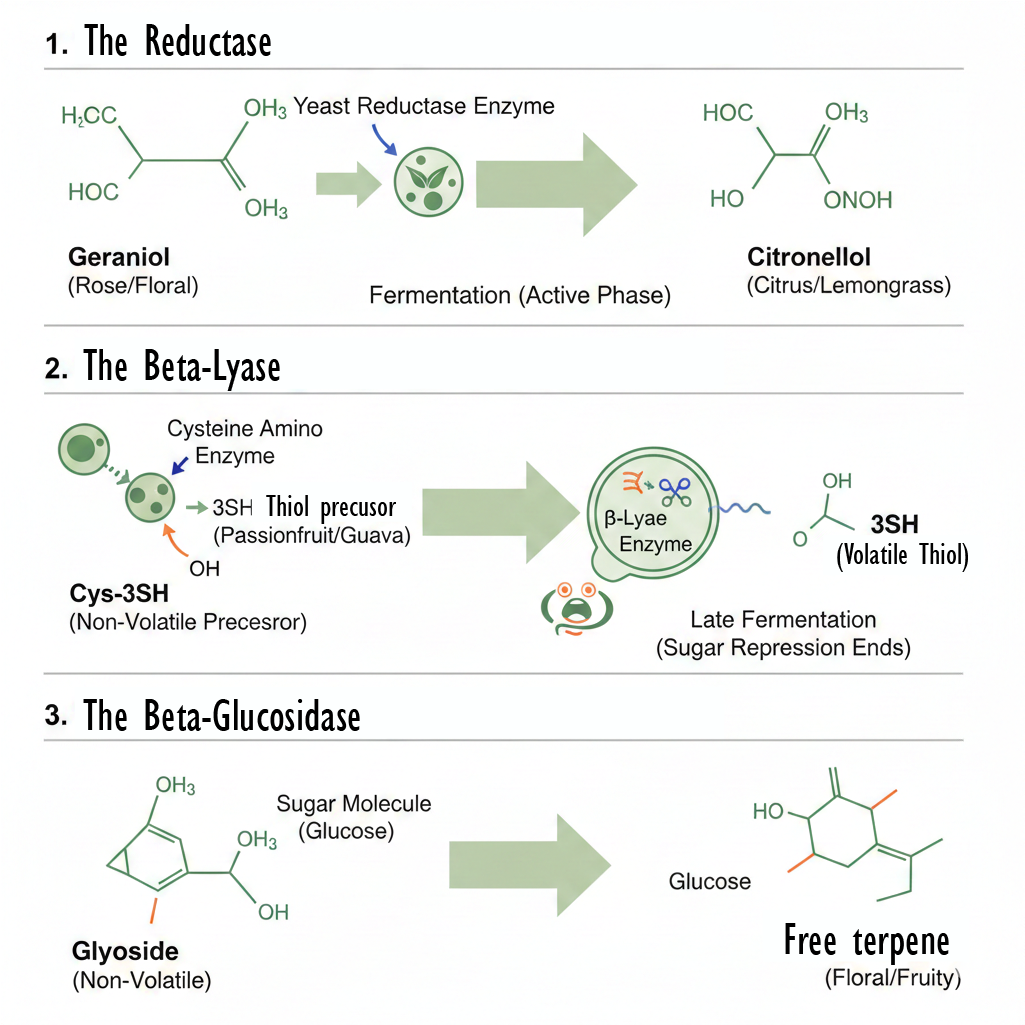
Terpene alcohol conversion: Reductase
Hop oils are rich in geraniol (rose/floral). During active fermentation, yeast can transform geraniol into citronellol (citrus/lemongrass). This process radically alters the beer’s aroma profile.
This is a modification of the molecular structure. Geraniol (rose-scented) is the main precursor. Under the action of yeast reductases, it undergoes a transformation:
- Geraniol -> Citronellol: Yeast reduces the double bond of geraniol. Citronellol has a much fresher lemon/citrus scent.
- Nerol -> Geraniol: Yeast can isomerize nerol into geraniol, increasing the floral potential before transforming it again.
Glycoside Hydrolysis: Beta-glucosidase
Many terpenes are “trapped”: they are bound to a sugar molecule (often glucose). These are called glycosides . In this form, the molecule is too heavy to evaporate (therefore, there is no odor) .
Yeast produces an enzyme, beta-glucosidase , which acts like a chemical scissor. It breaks the glycosidic bond, thus releasing the aromatic terpene into the beer.
Beta-lyase Release
Thiols are organic sulfur compounds. They are responsible for the notes of passion fruit, guava, and boxwood .
The mechanism of the precursor linked
In hops, thiols are mostly present as precursors bound to cysteine or glutathione . Example: 3-sulfanylhexan-1-ol (3SH) is bound to cysteine (Cys-3SH).
Yeast comes into play with the enzyme beta-lyase :
- The yeast absorbs the precursor (Cys-3SH) through its cell membrane.
- The Beta-lyase enzyme breaks the carbon-sulfur bond of cysteine.
- Free thiol (3SH) is released into the must.
Most strains of Saccharomyces cerevisiae possess the gene (IRC7) encoding this enzyme, but it is often “switched off” or inefficient. This is why laboratories select or modify strains.
These enzymes are produced by yeast for its own metabolism (often to capture carbon or nitrogen). Once fermentation is complete and the yeast enters dormancy (flocculation), enzyme production drops. This is why dry hopping must take place while the yeast is highly active.
The chemical balance of the must
The chemical balance of the wort (pH, nutrients) can promote the expression of these specific enzymes: To optimize these organic chemistry reactions, the brewer must act on the physico-chemical environment in the fermenter.
Yeast is a complex biological machine: its enzymes only function optimally under certain conditions of pH, temperature and availability of co-factors.
The influence of pH on enzyme activity
The pH of the must changes drastically during fermentation (from ~5.2 to ~4.2). However, each enzyme involved in biotransformation has a catalytic optimum :
- Beta-glucosidase: Its activity is generally maximal around a pH of 5.0 .
- Beta-lyase: Very sensitive to acidity, its activity is often inhibited in overly acidic environments.
Tip: Slightly raise the pH with potassium bicarbonate at the end of fermentation to maintain enzymatic activity and limit hop astringency.
Co-factors and Nutrients: The Role of Metal Ions
Enzymes like beta-lyase are often metalloenzymes . They require cofactors to function, including:
- Magnesium (Mg2+): Essential for many phosphate transfer reactions and the activation of glycolysis, which keeps the yeast vigorous enough to metabolize terpenes.
- Zinc (Zn2+): A critical cofactor for alcohol dehydrogenase and other bioconversion enzymes. For example, a must deficient in zinc will slow the conversion of geraniol to citronellol.
Glucose Inhibition
This is a fundamental point of organic chemistry: repression by sugars .
Many yeast strains only express beta-glucosidase genes when simple sugars (glucose) are depleted.
Tip: If you hop too early (right after pitching), the massive presence of glucose can “shut down” the production of biotransformation enzymes. The ideal time is often 24-48 hours , when the glucose is consumed but the fermentation of complex sugars (maltose) is in full swing.
The Precursors of Thiols
If you’ve ever smelled a bag of Nelson Sauvin hops, you’ve likely detected notes of white grapes. Yet, that same hop can impart explosive aromas of passion fruit or guava to the finished beer. This discrepancy is explained by thiol precursors : odorless molecules present in hops that only reveal their aromatic potential after a specific enzymatic process.
The Chemical Nature of Precursors
In hops, free (aromatic) thiols represent only a tiny fraction (less than 1%). The vast majority is locked up in the form of non-volatile precursors .
The two main forms:
Thiols are primarily bound to two organic molecules that “trap” them:
- S-Cysteine (Cys-): The thiol is bound to this amino acid. It is the most direct form for biotransformation.
- Glutathione (G-): A more complex molecule (tripeptide). It is the most abundant reservoir, but it requires two transformation steps before releasing the aroma.
Aromatic targets:
- 3SH (3-sulfanylhexan-1-ol): Brings notes of passion fruit and pink grapefruit.
- 4MMP (4-methyl-4-sulfanylpentan-2-one): Contains notes of blackcurrant bud and boxwood. The Release Mechanism (Biotransformation)
The intracellular process:
- Transport: The yeast must first bring the precursor (often Cys-3SH) into its cell via amino acid transporters.
- Cleavage: The beta-lyase enzyme breaks the Carbon-Sulfur bond (CS).
- Release: The now free and volatile thiol (3SH) escapes from the cell and dissolves in the beer.
Recommended hop varieties :
Hops rich in bound precursors (Cys-3SH / G-3SH):
These hops are perfect for adding during mash hopping or at the beginning of fermentation:
- Cascade : The undisputed champion of precursors. It offers the best value for money for “loading” a must with latent thiols.
- Saaz : Very rich in 3SH type precursors, despite its naturally noble and herbaceous aromatic profile.
- Pearl : Surprisingly rich in tropical fruit precursors.
- Calypso : Contains very high levels of bound precursors.
- Hallertau Blanc : A major source of precursors reminiscent of white wine (Sauvignon Blanc).
“New Generation” Hops (Free Spirits + Precursors)
These varieties provide immediate aromas and also supply fuel for biotransformation.
- Nectaron (NZ): Rich in free thiols (4MMP) and precursors.
- Nelson Sauvin (NZ): The benchmark for wine grape and passion fruit notes.
- Motueka (NZ): Very rich in related shapes reminiscent of lime and tropical fruits.
Tip: If you want to maximize thiols with European hops, I recommend:
- Use an older vintage of Perle or Cascade at mash-in (Mash Hopping) to release precursors into the wort at a lower cost.
- Use Hallertau White in Whirlpool at 80°C.
- Inoculate with a yeast strain rich in Beta-Lyase and Beta-Glucosidase
Focus on Mash Hopping
Mash hopping is the ultimate technique for extracting thiol precursors. Unlike traditional hopping, which targets volatile oils (terpenes), here the aim is to solubilize heavy and stable molecules: thiols bound to glutathione .
Here is a technical guide to successfully complete this step:
The physico-chemical parameters of Mash Hopping
The goal is to transfer hop precursors to the wort even before boiling.
- The timing: Add the hops right at the beginning of the mashing process, just after mixing the grain and water.
- Temperature: Thiol precursors (S-conjugated) dissolve perfectly between 62°C and 68°C . At this temperature, you do not extract bitterness (the alpha acids are not isomerized).
- pH: Maintain a standard mashing pH between 5.2 and 5.4 . Too high a pH could extract polyphenols (astringency) from the hop plant matter.
- Dosage: Aim for around 2 to 4 g of hops per liter of finished beer. For 20 L, plan on 40 g to 80 g of precursor-rich hops (Saaz, Cascade FR, Motueka).
Why doesn’t it “evaporate” when boiling?
This is the question all brewers ask themselves. Hop aromas are normally very volatile, but the precursors of bound thiols are non-volatile molecules .
- They are “weighed down” by the sugar or amino acid molecule to which they are attached.
- They therefore remain in the must throughout the entire boiling process.
- It is only once in the fermenter that the yeast will “break” this link to make the thiol volatile (and therefore odorous).
The risk of oxidation:
The biggest danger in mash hopping is oxidation. Hot wort is an oxygen sponge, and thiols hate that.
- The polyphenol trick: Adding hops to the mash provides natural antioxidants that protect the wort during transfer.
- “Hot Side Aeration”: Avoid splashing the wort during transfer to the boiling kettle. Use hoses that reach the bottom of the kettles.
Mash hopping is not a replacement for dry hopping. It’s a chemical foundation. Aim for 15% to 20% of your total hop load for mash hopping.
Focus on enzymes
If you don’t want to change your preferred yeast strain (for example, if you absolutely insist on using US-05 or WLP001 , which aren’t naturally very active on thiols), you can add exogenous enzymes . This is a common practice in winemaking that is becoming increasingly popular among craft brewers.
In brewing, the enzyme we’re looking for is beta-lyase . However, it’s rarely sold “pure.” It’s often found incorporated into enzyme preparations.
Market benchmarks:
- Aromazyme (Lallemand): This is the most accessible option for brewers. It contains beta-glucosidases that release terpenes and help with overall aromatic expression.
- Rapidase Revelation Aroma (DSM): Widely used by winemakers, this enzyme has strong thiol precursor cleavage activity. It works very well in beer wort.
- “Thiol-Lib” type enzymes: Some specialist suppliers are beginning to market specific mixtures of glycosidases and lyases to maximize 3SH.
When and how to add the enzyme?
For the enzyme to be effective, it must act while the medium is still in motion and before the pH drops too low.
- The ideal time: Add the enzyme at the time of pitching (when you add the yeast). The enzyme will begin breaking down the hop precursors immediately.
- Temperature: The enzymes work perfectly at classic fermentation temperatures (18°C – 22°C).
- Dosage: Generally very low, about 5g per 100 litres (always refer to the manufacturer’s technical data sheet).
Other techniques to consider
- The Whirlpool at low temperature (80°C)
Free thiols (which are already odorous) are extremely volatile and sensitive to heat.
After boiling, cool your wort to 80°C before adding your whirlpool hops.
At this temperature, the isomerization of alpha acids (bitterness) almost stops, but above all, you limit the evaporation of fragile thiols while allowing optimal extraction of the remaining precursors.
- “Dip Hopping”: The Japanese technique
Invented by the Kirin brewery, this technique consists of placing hops in the fermenter before adding the wort, then pouring the hot wort (approximately 75-80°C) over it.
This allows for rapid infusion extraction. But above all, starting fermentation immediately afterwards allows the CO2 produced by the yeast to “drive out” the oxygen, thus protecting the thiols from premature oxidation.
- Combating oxidation (Low Oxygen Brewing)
Thiols (like 3SH) have a sulfur function which oxidizes very easily into disulfides, which are completely odorless.
The use of potassium metabisulfite (KMS) or ascorbic acid (Vitamin C) in very small quantities in the mashing water helps to trap the oxygen that would destroy the hop thiols in the first few minutes.
Regularly purge your fermenters and CO2 lines. A single contact with air can halve the aromatic perception of thiols.
Fermenting under pressure is also a good way to preserve aromatic molecules in beer. However, be careful to maintain a pressure that is “viable” for the yeast (e.g., 1 bar).
- The “Phantasm” or grape skins
If you want to take it to the next level, adding Phantasm powder (Sauvignon Blanc grape skins) or grape stems to the Whirlpool provides a concentration of precursors (3SH) impossible to achieve with hops alone. It’s the most potent “fuel.”
- Dry Hopping (Early Dry Hop)
To maximize biotransformation, the timing of dry hopping is vital.
Add your Dry Hops when there are approximately 2 to 3 points of gravity remaining before the end of fermentation (often on day 2 or 3).
The yeast is still active enough to cleave the last precursors brought by this fresh hops, while consuming the oxygen introduced when the fermenter was opened.
The case of organic farming
Under the organic certification (Agriculture Biologique) according to European regulations, the use of additives or ingredients derived from grapes (such as skins, musts or extracts) is governed by two major principles: the certified origin of the product and its role in the recipe.
Agricultural ingredients (e.g., grape skins)
If you use dehydrated grape skins (like the Phantasm product) or fresh grape pods to provide thiol precursors:
- Mandatory certification: The product itself must be certified organic . You cannot add conventional grape powder to a beer certified organic (AB).
- The 95% rule: To bear the European organic logo, 95% of the agricultural ingredients must be certified organic. If your grapes are organic, they are included in this calculation just like malt or hops.
- The case of Phantasm: To date, classic Phantasm powder comes from Marlborough vineyards, not all of which are certified organic. However, there are alternatives (such as grapes from local organic winemakers) that perfectly fulfill this role.
Enzymes (Aromazyme, beta-lyase)
- Status of manufacturing aids: In the BIO regulation, enzymes are considered as “manufacturing aids”.
- Non-GMO origin: To be allowed in organic farming, an enzyme must not be produced by or from Genetically Modified Organisms (GMOs).
- Non-Ionisation: To be allowed in BIO, an enzyme must not have been ionised.
- Availability: You must check with your certifying body that the specific enzyme is on their list of authorized processing aids. Most conventional oenological enzymes are acceptable if they are guaranteed to be GMO-free and free of unauthorized preservatives (such as certain sulfites or benzoates).
Extracts and flavorings
- Natural flavors: If you use a “precursor extract” in liquid form, it must be labeled as “Natural flavor of [XX]” and at least 95% of the flavoring part must come from the source mentioned (e.g., grape).
- Prohibition of solvents: Extraction must not have been carried out with chemical solvents prohibited in organic farming (such as hexane). Only water, ethanol, or CO2 are generally permitted.
Before you begin, it’s best to have the products you plan to use validated by your certifying body. This applies whether it’s yeast, enzyme concentrate, mineral salts, etc.
And when purchasing all these products, make sure that your supplier is certified and that the products they offer are also certified.
Bibliography / Useful Links
Here is a compilation of scientific, technical and commercial references.
Scientific References (Leading Studies)
These articles form the basis for understanding terpene bioconversion and thiol release.
- Takoi et al. (2010): Synergistic Effects of Hop-Derived Volatile Compounds
- Subject: Demonstrates the synergy between geraniol and linalool and their regulation by yeast.
- Direct link (Journal of the Institute of Brewing)
- Holt et al. (2011): The Impact of beta-lyase Activity on Tropical Aroma
- Subject: Highlighting the importance of the beta-lyase enzyme for passion fruit aromas.
- Direct link (Applied and Environmental Microbiology)
- King & Dickinson (2003): Biotransformation of Hop Terpene Alcohols
- Subject: Pioneering study on the transformation of geraniol and nerol by Saccharomyces cerevisiae .
- Direct link (FEMS Yeast Research)
- Belda et al. (2017): Microbial Contributions to Wine and Beer Aroma
- Subject: Comprehensive synthesis on glycosidases and biotransformation enzymes.
- Direct link (Molecules)
Yeast Strains
Here are the links to the supplier specifications for strains optimized for biotransformation.
- Lallemand – LalBrew New England
- Fermentis – SafAle S-33
- White Labs – WLP067 Coastal Haze
- Omega Yeast – Star Party (Thiolized Series)
Pioneers of Thiols and Innovative Products
- Phantasm (Sauvignon Blanc grape skins)
- Official website Phantasm.nz
- Note: Site explaining the extraction of thiol precursors.
- Yakima Chief Hops – Work on the Thiols (3SH/4MMP)
- Lallemand – Aromazyme (Exogenous Enzyme)
Technical Concepts and Methods (Popularization)
- Scott Janish – “The New IPA”
- This book is the source of most of the synthesis schemes on pH, Mash Hopping and catabolic repression.
- Author’s Blog (Free Excerpts)
- Omega Yeast – “The Mash Hopping Project”
- Details the science behind adding Cascade/Saaz to the mash to release thiols.
- Link to the case study
Regulatory Documents and Summaries
- Regulation (EU) 2021/1165 (Additives and Enzymes in Organic Farming)
- To verify the use of exogenous enzymes (β-glucosidase) in biological production.
- EUR-Lex link