
The aromatic compounds of hops:
The aromatic compounds of hops are extremely complex and varied. There are more than 500 of them, but they are mainly classified into three major chemical families.
Here is a detailed list of the main compounds that give beer its flavors and aromas:
1. Terpene Hydrocarbons (50 to 80% of oils)
These are the most volatile and most susceptible to oxidation. They are often responsible for “fresh” aromas but escape easily when boiling.
- Myrcene: The most abundant. Contributes notes of pine resin , cut grass , and sometimes light citrus.
- Humulene: Typical of noble hops (Saaz, Hallertau). It gives that classic earthy , herbaceous and spicy character of Lagers.
- Caryophyllene: Adds hints of black pepper and wood .
- Farnesene: Present in smaller quantities, it offers notes of green apple or gardenia .
2. Oxygenated Compounds (20 to 50% of oils)
This is where we find the most “noble” and sought-after molecules by modern brewers, because they survive the brewing process better.
Terpene Alcohols
- Linalool: One of the most important. It gives a floral aroma of lavender , bergamot and coriander .
- Geraniol: Contains notes of rose and geranium . It can be transformed by yeast (biotransformation) into other fruity compounds.
- Nerol: Similar to rose with a more lemony touch.
Esters and Ketones
- They bring notes of ripe fruit (apricot, pear, small red fruits).
3. Sulfur Compounds: Thiols (Less than 1% of oils)
Although present in minute concentrations (parts per trillion), they have a huge impact because our nose is extremely sensitive to them. This is the heart of NEIPAs.
- 4MMP (4-mercapto-4-methylpentan-2-one): Aroma of boxwood , blackcurrant bud or cat pee (if too concentrated).
- 3MH (3-mercaptohexan-1-ol): Intense aroma of grapefruit and rhubarb .
- 3MHA (3-mercaptohexyl acetate): Very pronounced aroma of passion fruit and guava .
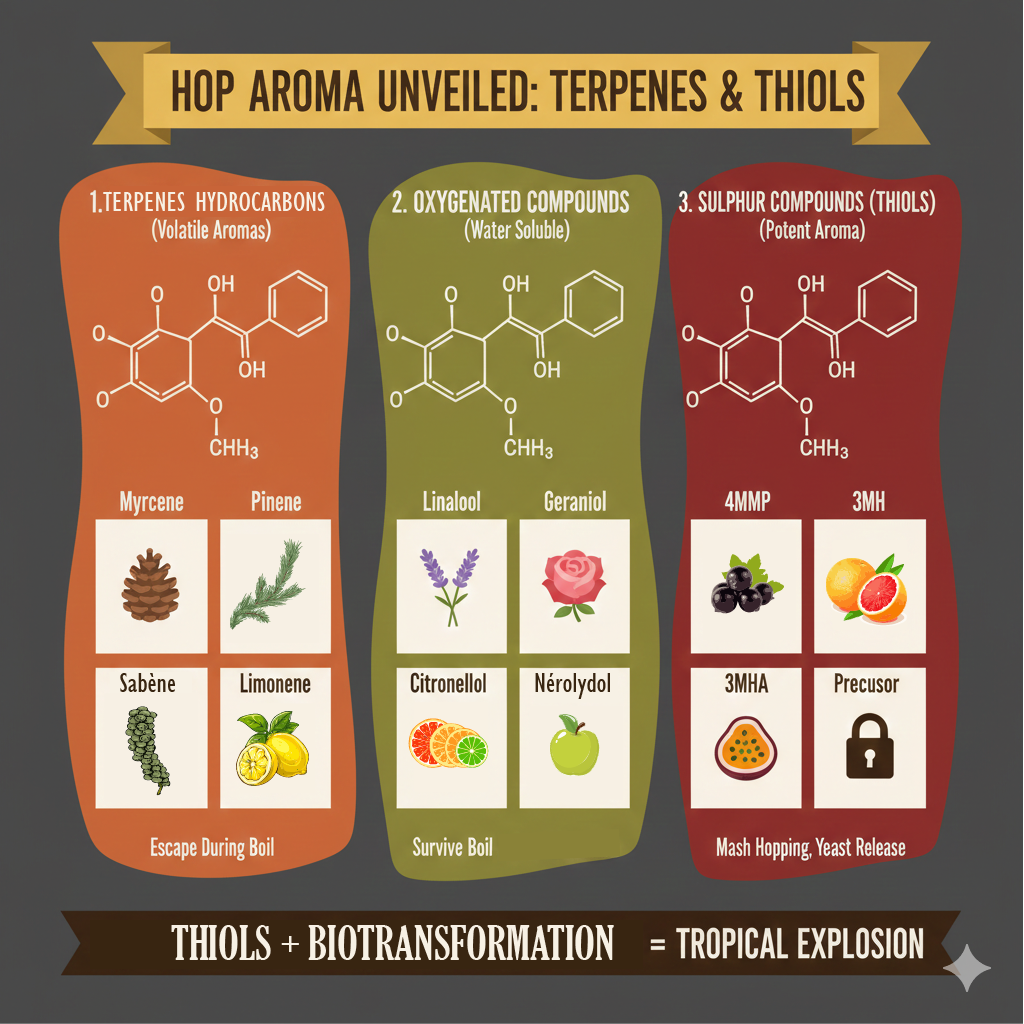
The three families of aromatic compounds
Comprehensive list of Terpene Hydrocarbons:
| Family | Chemical Compound | Aromatic Profile | Pictogram |
| Monoterpenes | Myrcene | Pine resin, cut grass | 🌲 |
| alpha beta-Pinene | Fir sap, Fresh | ❄️ | |
| Limonene | Lemon zest, Orange | 🍋 | |
| beta-Ocimene | Floral, Light Tropical | 🌸 | |
| Terpinolene | Pine, Floral Musk | 🌼 | |
| Sabène | Fresh spices, green pepper | 🌿 | |
| Sesquiterpenes | alpha-Humulene | Earthy, Woody, Noble | 🪵 |
| beta-Caryophyllene | Black pepper, Spicy | 🧂 | |
| beta-Farnesene | Green apple, fresh floral | 🍏 | |
| alpha\beta-Selinene | Damp soil, Herbaceous | 🌱 | |
| alpha-Copaene | Precious wood, Spices | 🪵 | |
| Germacrene D | Soft woody, floral | 💐 | |
| Delta3-Carène | Cedar, Soft Resin | 🪵 |
In a GC-MS report analyzing hop aromatic compounds, you will generally only see the first four (Myrcene, Humulene, Caryophyllene, Farnesene) because these are the only ones whose concentration is sufficient to significantly impact the sensory profile of the beer on their own. The others contribute to what is known as the “bouquet” effect through synergy.
These compounds (especially monoterpenes like Myrcene) are the first to evaporate. If you want to keep the “Pine/Fresh Grass” character of Myrcene, opt for Dry Hopping or Whirlpool at low temperatures (< 80°C).
Hydrocarbons are very sensitive to oxygen. A beer that loses its resinous “pep” in favor of a cardboard taste is often a sign of the degradation of these molecules.
Comprehensive list of Oxygenated Compounds:
| Family | Chemical Compound | Dominant Aroma | Pictogram |
| Terpene Alcohols | Linalool | Floral, Lavender, Bergamot | 💐 |
| Geraniol | Rose, Geranium | 🌹 | |
| Citronellol | Lemongrass, Citrus | 🍋 | |
| alpha-Terpineol | Lily of the valley, Lilac | 🌸 | |
| Nerolydol | Rosewood, Apple | 🍎 | |
| Esters | Isobutyl isobutyrate | Pineapple, Exotic Fruits | 🍍 |
| methyl 2-methylbutyrate | Ripe apple, Apricot | 🍑 | |
| Methyl isovalerate | Wild berries, strawberries | 🍓 | |
| Ketones / Aldehydes | beta-Ionone | Violet, Raspberry | 🍇 |
| 2-Undecanone | Orange blossom | 🍊 | |
| Hexanal | Cut grass, green apple | 🍏 | |
| Oxides (Sesquiterpenols) | Humulene oxide | Dry wood, Spices, Fern | 🪵 |
| Caryophyllene oxide | Earthy, Woody | 🌿 |
Solubility: These molecules are much more soluble than hydrocarbons, which explains why they have a greater impact on the final taste of the beer.
Comprehensive list of Sulfur Compounds:
| Technical Name | Abbreviation | Dominant Aroma | Pictogram |
| 4-mercapto-4-methylpentan-2-one | 4MMP | Blackcurrant bud, Boxwood, (Cat pee) | 🐈⬛ |
| 3-mercaptohexan-1-ol | 3MH | Pink grapefruit, rhubarb | 🍊 |
| 3-Mercaptohexyl acetate | 3MHA | Passion fruit, Guava | 🥭 |
| 3-mercapto-4-methylpentan-1-ol | 3M4MP | White grapefruit, bitter citrus fruits | 🍋 |
| 4-mercapto-4-methylpentan-2-ol | 4MMPO | Woody notes, tropical fruits | 🪵 |
| S-conjugates (Cysteine/Glutathione) | Precursors | Odorless before processing | 🔒 |
Unlike hydrocarbons (Myrcene) which are damaged by heat, thiol precursors are very stable. This is why mash hopping works: these precursors are extracted at the beginning so that the yeast can later transform them into explosive aromas.
Thiols oxidize faster than terpenes (like myrcene) when exposed to air. A beer rich in thiols loses its tropical “brightness” very quickly if the conditioning isn’t perfect. Oxidation transforms those fresh fruit notes into notes of cardboard or overripe fruit.
Beware of copper: Thiols have a strong affinity for copper ions. If the wort is in prolonged contact with copper, the thiols bind to the metal and precipitate, thus disappearing from the final beer. Stainless steel is therefore an ally for tropical aromas.