

The different hopping techniques in beer

Article written in collaboration with Alexandra Berry
Hops are one of the four essential elements for creating beer. Not only do they impart bitterness and the various aromas found in our glasses, but this small plant also has preservative properties that have greatly contributed to the development of beer over the centuries.
Once harvested, hops are dried and stored in a cool place to ensure proper preservation, often pelletized. Pelletizing involves crushing the dry hops to produce a powder with homogeneous aromatics and acids before being formed into pellets. Both forms of hops are suitable for brewing, although pellets are widely preferred by brewers today. Pellets allow for consistency in bitterness and aroma across batches, precise control of IBU ( International Bitterness Unit ) and aromatic yield, and less loss. While cones generally produce fresher and more potent oils than pellets (provided they are used within hours of harvesting), the beer loss when filtered through the flowers is still around 6%.
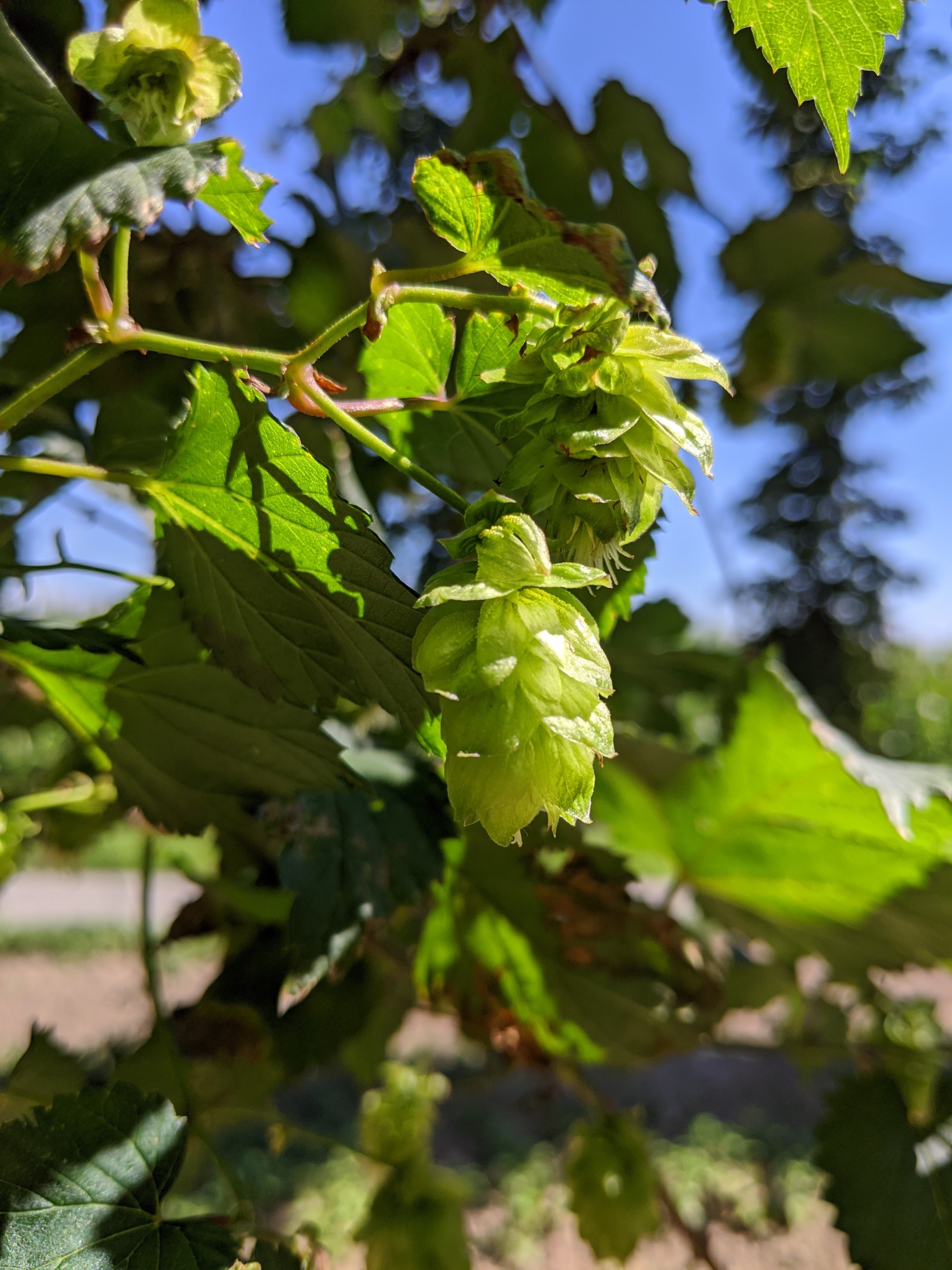
There are several types of pellets: T-90 and T-45 . Identical in their manufacturing and packaging, T-45 is more concentrated in lupulin. After being milled, the hops are sieved at -35°C, which removes their plant matter and leaves only a concentrate of essential oils. This increases the alpha acids while reducing the amount of material used. This means less raw material and less waste during brew filtration for the same aromatic result. However, these pellets are less common and more expensive.
Some brewers have also used hop extract , an extraction process patented by JR Whiting in 1875. Also known as CO2 Hop Extract , it is a resin produced by CO2 extraction from hops, concentrating their essential oils. The advantages are to further reduce material losses during brewing, to accurately measure flavoring and IBU levels, and to reduce storage and transportation needs. This process, however, takes us even further from the raw material itself, resulting in a relatively energy-intensive transformation.
In short, everyone has to make their own choices 😉
Some hopping techniques used
Regardless of the hop variety chosen, several hopping techniques are possible depending on the aromas and recipe the brewer wants to create. Every detail will influence the final recipe: the variety and quantities, of course, but also the temperature, boiling and fermentation times…
Mash Hops
This technique involves adding hops directly to the wort (barley heated with water) in the mash tun. By adding the hops immediately, their oils dissolve into the mash, and this technique allows for the development of an aromatic balance. The bitterness will be rather subtle, but the aromatics will be prominent in the finished product. However, this requires a large quantity of hops and results in significant losses without yielding a substantial aromatic impact on the brew. For brewers wishing to try this method, it is advisable to add bittering hops afterward.
First Wort Hopping (Hoping the first wort, pre-boil)
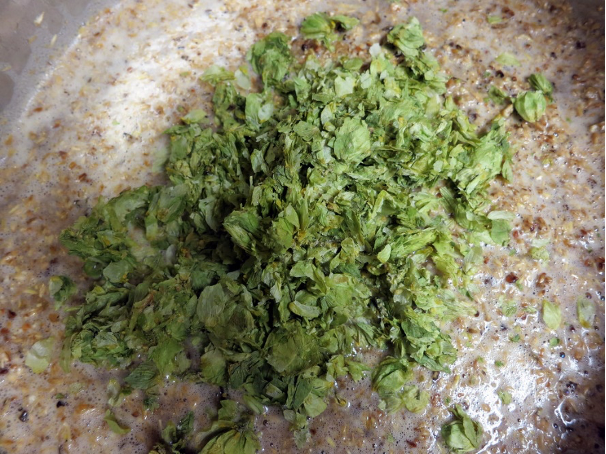
A traditional German technique, First Wort Hopping involves adding hops to the hot wort (around 70-80°C) as it is being filtered and transferred to the boil kettle. As the kettle fills with wort, the hops infuse it at a moderate temperature. This allows them to gently release their essential oils without them completely evaporating. This technique also solubilizes these oils in the wort, preserving them during the boil, when the hop bitterness is imparted. This bitterness will be less harsh on the palate than with conventional hopping, resulting in a more pronounced aromatic complexity. Noble hops, often called “finishing hops,” with their highly aromatic characteristics, are preferred for this technique due to their interesting profiles and low alpha acid content.
The effects of First Wort Hopping are similar to those of a dry-hop (see below), highlighting the aromatics without developing bitterness, often used to brew a Pilsner or to highlight an aromatic profile of an IPA.
Boil Hopping
There are three types of hopping: bitter hopping , aroma hopping and continuous hopping.
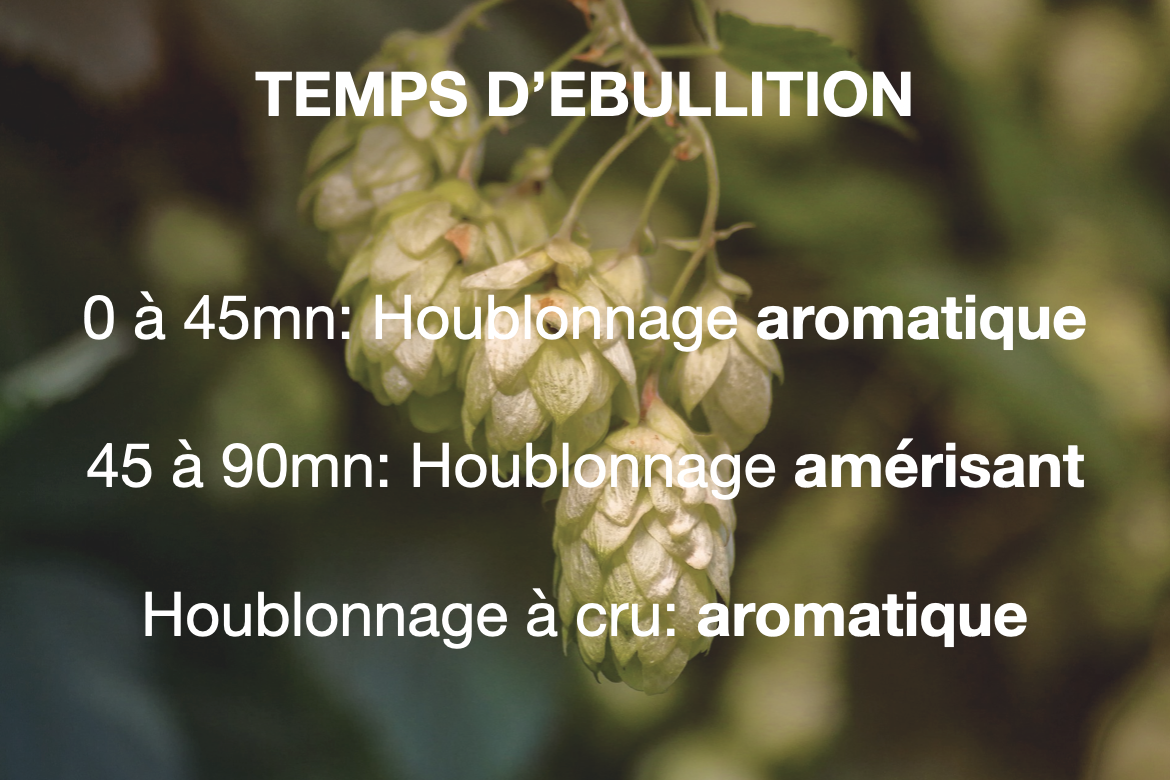
The conventional method for bittering hops is to add them at the beginning of the boil to isomerize the alpha acids (these acids are what give the bitterness). The earlier the hops are added during the boil, the more their bitterness will be emphasized at the expense of their aroma, as the essential oils evaporate.
The brewing time will depend on the desired IBU level as well as the hop variety, generally ranging from 60 to 90 minutes. Therefore, hops with high alpha acid levels are recommended for this type of brewing.
This is where aroma hopping comes in, which prioritizes aroma over bitterness. Often added after the initial hopping, it involves adding aromatic hops low in alpha acids during the last 10 to 15 minutes of the boil to preserve the essential oils. As you might have guessed, hops with strong aromatic properties are particularly favored for this purpose.
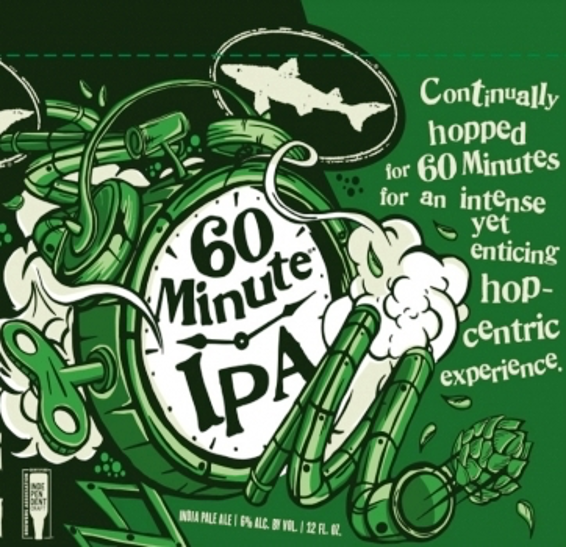
Finally, there’s continuous hopping , which involves adding small amounts of hops throughout the boil. This allows both the bitterness and aroma of a hop variety to be brought out. Generally, this method is applied in the last 40 minutes of the boil and can be adapted to any type of hop, boil time, and quantity, depending on the brewer’s desired result.
Post-boil Hopping
There are several ways to perform post-boil hopping.
The first method is flame-out , also called late hopping , which involves adding hops at the end of the boil, when the water is still hot (over 70°C). This ensures the extraction and preservation of essential oils. The hops are left in for about fifteen minutes to allow the aromas to be extracted while the wort cools. This process imparts the floral and fruity aromas sought after in certain varieties. It’s also possible to use a large quantity of bittering hops to achieve a generally milder bitterness in the finished beer.
The second stage is during whirpooling (a centrifugal beer-making technique to concentrate the sediment in the center of the kettle for filtration): once the wort temperature has dropped to between 60 and 80°C, the ideal temperature for flavoring. Also known as the Hop Stand , this technique allows for maximum extraction of hop aromas, particularly the aromatic oils called myrcene. These oils are what give the beer its citrus and tropical fruit aromas. The brewer can also use a hopback , which is a hop container connected in series between the kettle outlet and the chiller. The still-warm wort is thus infused with hops as it leaves the kettle, receiving fresh aromas and essential oils just before fermentation.
The last method, and probably the best known today, is dry hopping. With dry hopping, the brewer adds the hops directly to the fermentation vessel. Again, they can choose to add them at the beginning or end of fermentation, depending on their preferences. This allows for the extraction of all the hop aromas without bitterness, and it’s a technique particularly used to obtain very floral or fruity IPAs. This dry hopping generally takes place over 4-5 days at a temperature of 15°C before undergoing cold crashing, a cooling process lasting 2 to 3 days.
Finally, it’s also possible to hop your brew during the secondary fermentation (to create CO2 in the beer), and therefore just before bottling or kegging. This results in fermentation under pressure, which best preserves the essential oils of the hops – and thus all their aroma!
Thus, each technique will have its impact on the final brew. That said, every brewer can have fun and experiment with different hop varieties, fermentation times, or even the type of hops used! With new varieties constantly being created, the hopping possibilities are endless and promise a new flavor discovery with every sip.
To learn more:
Acitelli, T., (2013), The Audacity of Hops , Chicago Review Press Inc., Chicago.
Brown, P., (2017), Miracle Brew , Chelsea Green Publishing.
Hieronymus, S., (2012), For the Love of Hops, The Practical Guide to Aroma, Bitterness and the Culture of Hops, Brewers Publication,
Mosher, R. (2004), Radical Brewing: recipes, tales and world-altering meditations in a glass, Brewers Publications, Division of the Brewers Association, United States of America.
Steele, M., (2012), IPA Brewing Techniques, Recipes and the Evolution of Indian Pale Ale , Brewers Publications, Boulder, Colorado.