
Dry Hopping: We’ll tell you everything (or almost everything!)

Dry hopping is a term we hear and use a lot when talking about craft beer. Let’s take a closer look, so it might give you some ideas too 😉
Article written in collaboration with Alexandra Berry
Overview
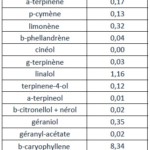
As everyone knows (yes, really ;-)), hops are composed of essential oils that provide aroma, and alpha acids which, once isomerized, give beer its bitterness. This isomerization occurs at a temperature above 85°C. Thus, the earlier the hops are added during the boil, the more bitterness they will impart. However, hops contain components such as terpenes and hydrocarbons like linalool, myrcene, humulene, and geraniol, which evaporate during boiling. Myrcene is the most abundant essential oil in hops, sometimes making up 60% of the gland’s chemical composition, and is the most susceptible to being affected by excessively long boiling times. Each of these components imparts specific aromas to the hops, which are found in the controlled final product. If added too early during the boil, they will have no aromatic impact on the brew. However, if added to a cooled brew during fermentation, these aromas are enhanced and easily extracted upon contact with the liquid.
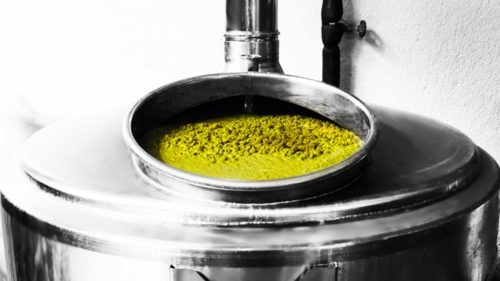
Dry hopping is a technique that involves adding hops after boiling, that is, during fermentation or when the beer is barreled. This brief contact with the beer allows for the extraction of aromas without imparting excessive bitterness or astringency. Dry hopping can last a few days at a temperature ranging from 4 to 20°C . It is recommended to stir the beer once a day to promote the extraction of the hop components.
However, it is possible to use hops with a high alpha acid content during hot dry hopping. This allows the acids to be isomerized to add bitterness, while also revealing the hop’s aromas.
It’s also important to keep in mind that during a dry hop , the yeast is still active in the fermentation tanks and can alter the hopped components. The brewer must therefore decide whether to keep or remove the yeast before dry hopping .
There are no restrictions or recipes to follow for dry hopping; it’s up to the brewer’s creativity to imagine what type of beer they want to create and what aromas they want to emphasize. Indeed, to control the dry hopping process, the brewer must know the chemical characteristics of the chosen variety (its aromatic components and alpha acid content), but also its place of origin, harvest date, and ideal isomerization temperatures.
The technique also adapts to the type of brewery equipment and the quantities brewed. In fact, it seems particularly well-suited to microbreweries : the more contact the hops have with the liquid, the more aromatic compounds they can transfer. Therefore, it is perfectly adapted to small tanks.
However, the yeast in suspension can metabolize dissolved oxygen, thus preserving the beer from oxidation.
Hop shape
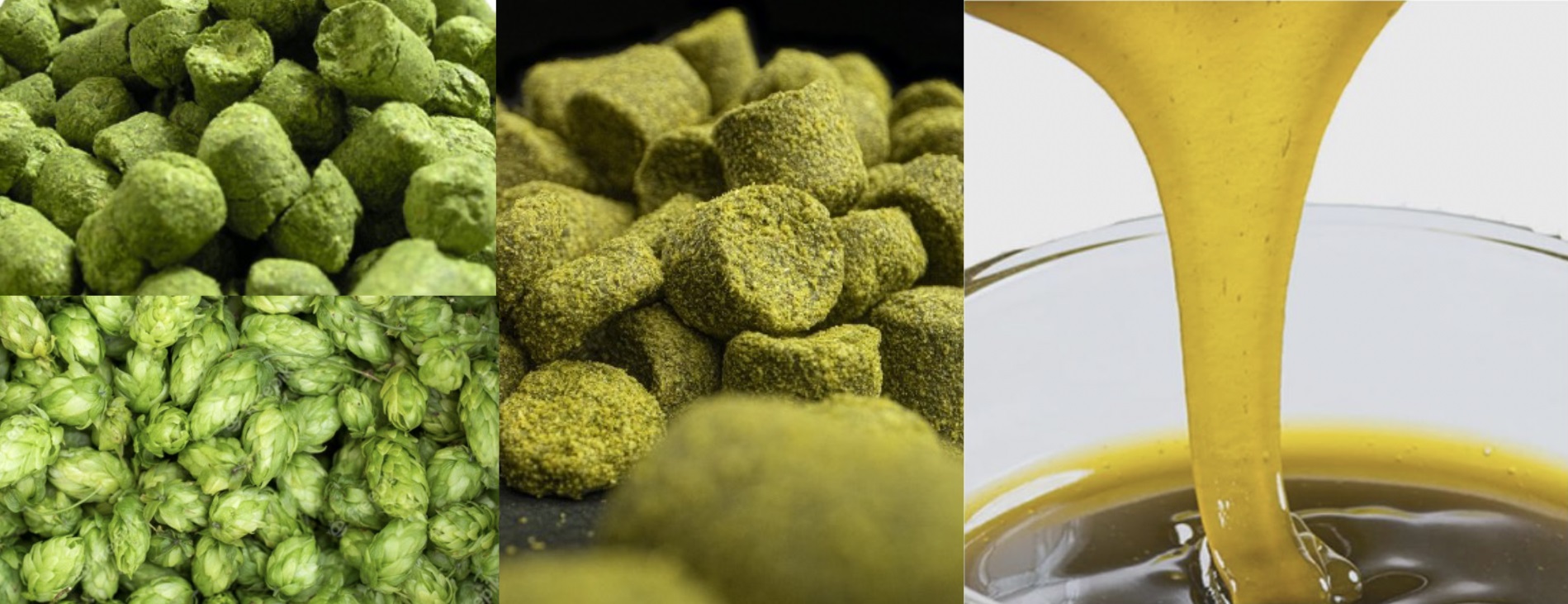
The hops used for dry hopping can be in cone or pellet form (or even as extract):
- The cone provides natural extraction, but it tends to float to the surface, absorbing more must. Therefore, during filtration, the liquid loss is quite significant (approximately 7%).
- The pellets will dissolve, resulting in better extraction of their components. However, they can cloud the beer if a cold crash —meaning rapid cooling—is not performed after dry hopping .
For dry hopping , pellets are generally recommended . Since the hops have already been crushed, their lupulin mixes easily with the liquid for better flavor extraction.
Extraction is also between 5 and 10% more efficient with the pellet than with the cone.
Regardless of its form, it can be contained in a hop bag, a Hop Tube , or added directly to the wort. The bag allows for easy removal of all the hops, but limits extraction and contact between the components and the liquid (not to mention that the bag becomes very heavy to remove soaked from the kettle when working with large quantities).
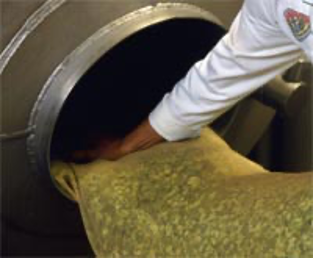
Different Dry Hop Techniques
Dry Hop Duration
The extraction of compounds during dry hopping lasts between 1 and 3 days . Several studies have shown that the greatest extraction occurs within 24 to 36 hours. Thus, hops can infuse for 3 to 5 days, but it is not recommended to leave them longer, as this risks giving the beer a grassy taste.
The ideal temperature is between 10 and 14° to avoid hop creep .
Hop creep occurs when hops release enzymes that hydrolyze dextrins. This transformation produces fermentable sugars, a process known as over-attenuation. This leads to off-flavors, changes in alcohol content, and, most importantly, the creation of CO2. The best approach is to keep the hops in contact with the beer for three days at a temperature of approximately 10°C (50°F).
Hot dry hopping : first fermentation
Hot dry hopping involves adding hops at the end of the boil, to a beer at around 19°C (66°F). In this batch, the yeast is still active and feeds on the sugars extracted from the hops, thus triggering fermentation. The pH, alcohol content, and gravity of the brew will therefore be altered accordingly, in addition to a higher concentration of hop compounds and an increase in alpha acid levels (and therefore perceived bitterness).
This primary fermentation is accompanied by agitation and CO2 production. Both will impact the evaporation of essential oils and lead to a loss of aromas.
Cold dry hopping : second fermentation or aging
To extract and enhance the aromatic qualities of hops, it is generally recommended to dry hop at the end of secondary fermentation, or in other words, during the conditioning period.
Once the hopping is complete, it is advisable to perform a cold crash , which involves lowering the temperature for cold conditioning. The suspended particles in the wort will settle to the bottom of the tank, resulting in a clarified liquid.
It is advisable to perform a cold crash of 2-3 days at a temperature of approximately 3° before proceeding to conditioning.
Static Dry Hop
Static dry hopping refers to simply adding hops to the fermentation vessel. Since agitation is usually done by hand, this technique reduces extraction time but involves contact with air, thus promoting hop oxidation. This can lead to the extraction of polyphenols, resulting in more herbaceous and astringent aromas. To avoid this, some fermentation vessels allow hops to be added from the bottom, enabling contact with the liquid without the risk of oxidation.
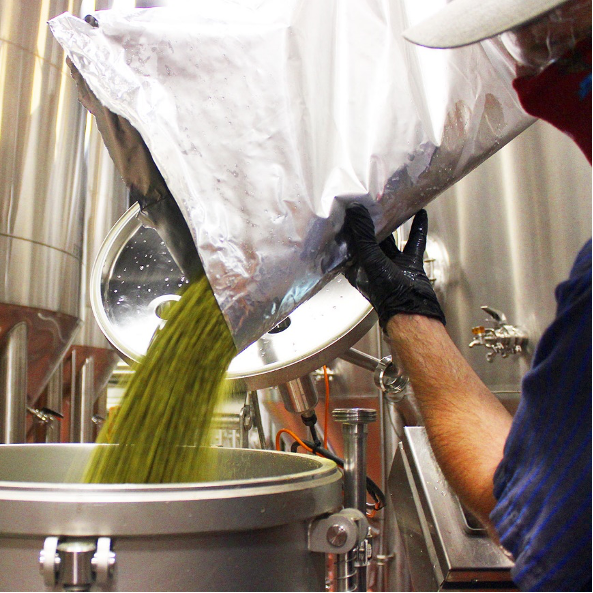
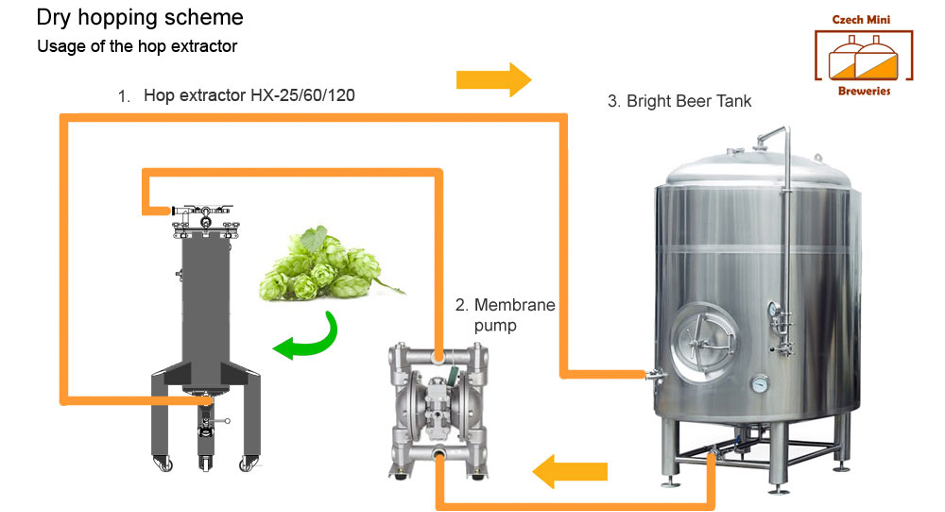
Dynamic Dry Hop
Invented in the 2000s, dynamic dry hopping circulates the beer between the fermentation tank and an external unit containing a filter. This filter can be tangential or plate-type, into which the hops are placed. The circulation of the beer between the two units promotes extraction, hopping, and the required hop quantities (50% less than with static hopping).
Hop Gun
The use of a hop gun is recommended for traditional brewing tanks because hops are added using CO2. This helps to expel residual oxygen and preserve all the aromas. However, this addition of CO2 can lead to increased foam in the finished product.
Iso-Mix External Drive
In 2017, the ISO-MIX EXTERNAL DRIVE was created; a rotary jet mixer that is placed under the brewing vessel. This allows for the dispersion of solids with a homogeneous suspension of hops within the vessel. This reduces the required hopping doses by 20% and the hopping time by 15%. Given its cost and ease of use, it will be of greater interest to large breweries with substantial brewing vessels and capacities of up to 100 hectoliters.
Warnings
Dry hopping, while used to flavor beer, can actually increase both the perceived and measured bitterness of the brew by altering its components. Hops are a bitter plant, and any addition of hops also contributes bitterness.
A dry hop sometimes promotes the creation of foam and, if poorly controlled, can lead to gushing , you know, when the beer spurts everywhere like a hoppy fountain!
Dry Hop, Double Dry Hop, Triple Dry Hop…
So we understand, dry hopping consists of adding hops to the brew after it has boiled, but with the trend of IPAs and aromatic American or New Zealand hops, many brewers are going much further.
As mentioned, it’s perfectly possible to add hops during the primary fermentation to further enhance bitterness and bring out the beer’s aroma, before adding a second hopping during conditioning, prior to cold crash, to emphasize only the aromas. For this second hopping, varieties with very strong characteristics are recommended: Nelson Sauvin , Sorachi, Sabro, Citra®, or Motueka, among others.
For a triple dry hop , unsurprisingly, three hopping stages are required. The last stage can be done just before packaging.
Each brewer will find their preferred technique depending on the desired flavor profile, the equipment available, and the hop varieties chosen. With the expansion of hop research and innovation, recipes are multiplying, allowing us to discover new flavors in our glasses every day.
To learn more…
Janis, S., (2019), The New IPA: Scientific Guide to Hop Aroma and Flavor, ScottJanish.com .
Hieronymus, S., (2012), For the Love of Hops, The Practical Guide to Aroma, Bitterness and the Culture of Hops, Brewers Publication.
Steele, M., (2012), IPA Brewing Techniques, Recipes and the Evolution of India Pale Ale, Brewers Publications, Boulder, Colorado.
https://wildabouthops.nz/dry-hopping-beer.html