SAVE ORGANIC

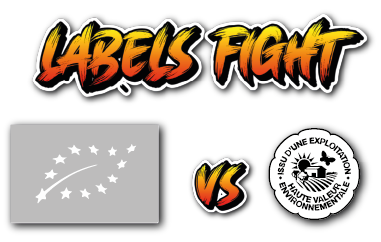
A group has formed to defend organic farming, and because enough is enough, HOPSTORE is joining them. What about you?
Where does the HVE label come from?
We are at the Grenelle Environment Forum in 2007, and it is noted that respect for biodiversity and water resources must be given greater consideration in agricultural practices. Unfortunately, these two specific points are not included in the organic label, whose specifications cannot be changed with the wave of a magic wand, as it has been a European label since 1991. A proposal is then made to create a new, purely French label: the High Environmental Value (HVE) label , which comes into effect in 2012.
To understand this better, let’s remember that this label is broken down into 3 levels:
- Level 1: Compliance with current agricultural regulations
- Level 2: encourages recognition and identification of biodiversity areas on the farm (hedges, etc.)
- Level 3: This is the certifying level, valid for 3 years, and allows the farmer to use the HVE logo; it is divided into two possible options.
- OPTION A: “consists of a set of specifications including requirements for biodiversity, plant health strategy, fertilization and irrigation management. For each category, various indicators assess the “ environmental performance “ of exploitation” ( source ).
- OPTION B: This option benefits farmers who are doing well, since it looks at the ratio – which must not exceed 30% – between input costs and farm revenue.
All the details are here . Enjoy!
HVE: a label with very low value
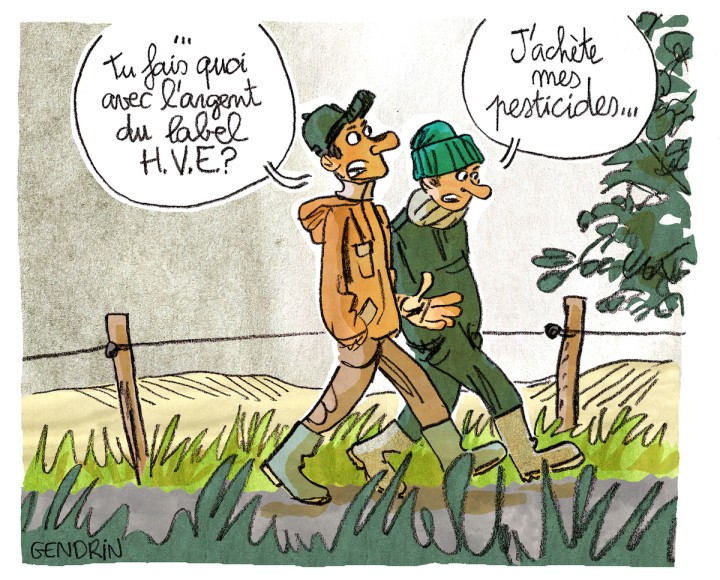
This label is far too lenient! It only requires that at least 10% of the farm’s total area be dedicated to biodiversity to qualify. These biodiversity zones can include hedgerows, grass strips, beehives, and so on. In short, you only need to change almost nothing and simply count what already exists to boast of having a “High Environmental Value” farm. It’s a disgrace and an abuse of the system.
And on this point, there is no debate:
The Court notes that, in all areas, the actions of the Ministry of Agriculture and Food Sovereignty are insufficient to meet its stated ambitions. It alerts public authorities to the lack of communication regarding the beneficial impacts of organic farming, and especially to the opacity of the labels, which contributes to the decline in organic food purchases in 2021 in the face of increasing competition from less demanding “green” labels – such as the prestigious “High Environmental Value” (HVE) designation.
Report of the Court of Auditors on support for organic farming
So we might say, like some, “yes, but it’s a start…” well, no, not even that.
“The problem is that the HVE label, which was originally conceived as a step towards organic farming, has become an end in itself for many players. Yet it remains woefully inadequate in the face of the ecological challenge.” »
Cécile Claveirole, Head of the Agriculture Network at France Nature Environnement
Abuse and Unfair Competition
This label could have been interesting because it takes into account factors that are sorely lacking in the Organic label, it must be acknowledged.
An abuse against the consumer
But it takes almost nothing to put a nice logo on products and make consumers believe that the practices they represent are virtuous: “The name HVE refers to a notion of excellence that we are not sure is actually achieved ,” says Charles Pernin, general delegate of the professional association Synabio. “There is a risk of confusion for the consumer.”
With this well-marketed logo, consumers are tempted to believe that the products are respectful of our health and the environment. Moreover , the association’s website states that:
” At the end of the certification process, the “High Environmental Value” designation attests to areas and operations that:
- By encouraging biodiversity in order to offer a complementary network to crops
- They preserve soil life to maintain the health and fertility of the plots.
- They develop positive synergies with the natural environment of the crops
- They promote the development of beneficial wildlife , including valuable pollinators .
A huge joke.
Especially since the selling prices are much lower than those of labeled organic products (logically, since they do not have the characteristics of organic products), in these times of inflation, HVE products are welcomed by our wallets: by buying an HVE product, the consumer has the impression of supporting a quality and respect approach at a reasonable cost when this is not the case!
And that’s not all!
Public funds that could go to organic farming
Although the label had a slow start, the government has announced an ambitious target of 50,000 farms committed to it by 2030. And to encourage more farmers to follow this path, the 2021 Finance Law includes a tax credit of €2,500 for farmers certified under the High Environmental Value (HVE) label. Total cost to public finances: €76 million. Quite a sum!
Meanwhile, the Court of Auditors points out that ” the Common Agricultural Policy (CAP) aid that France allocates to organic farming is not up to the objectives it has set for itself. Half of the budget was used up in the first year of the programming period, which began in 2015. In 2017, the aid for maintaining organic farming status was eliminated, even though it compensated for the environmental services provided by these farms. As a result, a quarter of organic farms do not receive any CAP aid .” ( Court of Auditors report ).
What a shame! Especially when you consider that France’s objectives are to reach 18% organic farmland by 2027 and 25% organic farmland across the EU by 2030! But no doubt we’re used to inconsistencies by now…
In short, we must react.
We are experiencing the hardship, and perhaps you are too: the organic sector has been slowing down for several months now. But not the High Environmental Value (HVE) certification! A 7% decrease for the former and an 8% increase for the latter (figures presented on the program SURLEFRONT on France 5 )!!! If we don’t want it to disappear, we must act!
The organic label isn’t perfect and it certainly has shortcomings. But it remains the most demanding nonetheless and points in the right direction: producers must be encouraged to make these efforts and consumers must be informed about what’s available.
In parallel, let’s make our voices heard: a collective has been created initiated by 3 professionals in the organic sector: Simon Le Fur (Aventure bio, wholesaler), Philippe Delran (Biolinéaires, publisher), Jean-Christophe Bernard (MoRice, organic brand) to say STOP to the contempt for Organic and we join their fight.
Demands of the Collective:
” That the Ministry of Agriculture once again considers the organic sector as a promising sector, and that it proposes a fair emergency support plan, in line with the support plans for conventional sectors, i.e. between €150 million and €300 million. “
For your information, here are the budgets allocated to organic farming:
- €10 million in emergency funding for organic farming announced at the Agricultural Show +
- €1.25 million for education/advertising +
- A €60 million fund – not exclusively for organic farms – for farms affected by climate disasters: what exactly do we mean by “climate disaster”? And for how long?
- + an obligation for public establishments to have at least 50% “quality” products – uh… – and 20% organic products, representing a total demand-side support of approximately €120 million: besides, why not just have 70% organic/biodynamic products directly…?
As you can see, these funds are often indirect – not going directly into the farmers’ pockets – hypothetical, and scattered. This is a far cry from the tax credit directly allocated to HVE-certified farmers.
To join us:
- A petition is online here.
- A downloadable leaflet with a QR code – which you will also find on the boxes shipped by HOPSTORE – will allow you to communicate and invite your ecosystem to participate in this movement.
Because the survival of many activities, including our own, depends on it, and because these abuses are becoming intolerable, we are mobilizing to save organic farming. Join us!