
The creation of new hop varieties


Article written in collaboration with Alexandra Berry.
Hops offer a world of possibilities that are increasingly being explored and improved. Indeed, with over 300 varieties available on the market – fewer organic, as you may have noticed – brewers have plenty of choice! In a world where innovation seems to be an essential value in the markets, new varieties are constantly being developed.
Why create new varieties?
Without varietal development, we would likely not experience the fruity bitterness and aromatic explosion of American-style IPAs that we have enjoyed in recent years. But the pleasure of taste isn’t the only motivation for developing new varieties. Performance also depends on what happens in the fields, where yields must be achieved through increased resistance to climate change and disease, greater adaptability to storage, a more concentrated oil content, higher alpha acids, and so on. And let’s not forget that hops are a historically medicinal plant with therapeutic properties whose benefits are still being explored and improved.
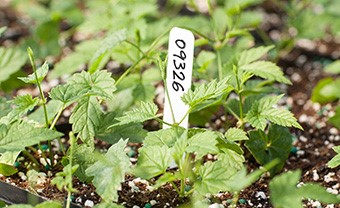
Source: https://www.hopsteiner.com/
Understanding hops
Hops ( Humulus lupulus ) is a flowering plant whose seed has two embryonic leaves. Hops belong to the dicotyledonous family (like roses, apples, and strawberries, for example) and more specifically to the Cannabaceae family (making them related to hemp and cannabis). There are actually three species of hops: Humulus yunanensis, H. japonicus, and H. lupulus, the latter being the species used in brewing.
Hops are dioecious*: they have separate male and female flowers on distinct male and female plants. These flowers are the small hop cones, filled with oils and rich aromas. Hop plants have ten chromosomes, nine of which are autosomes (normal chromosomes). The last chromosome determines the sex of the plant. Indeed, like humans, hops have X and Y chromosomes; a plant with one XX chromosome will be female, and one with one XY chromosome will be male. Note that although we name them the same, the X and Y chromosomes of hops are not homologous to those of humans.
Wild hop varieties are diploid, meaning they possess two sets of chromosomes, one inherited from the mother and the other from the father. Some commercial cultivars are triploid, meaning they possess three sets of chromosomes.
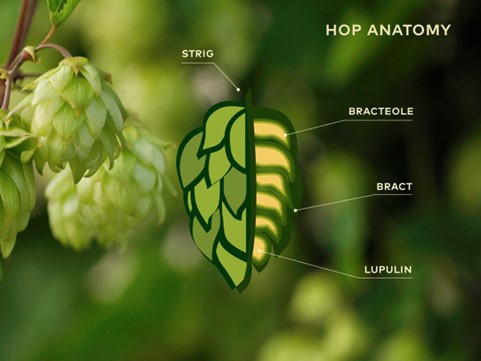
Hop reproduction
In nature, hops reproduce sexually. Pollen from the male plant—which carries one copy of each of its ten chromosomes—landes on the female cone and fertilizes an ovule. The ovule also carries one copy of the chromosomes. The fusion of the pollen and the ovule creates a zygote , which contains two copies of each of the ten chromosomes.
This zygote is encapsulated in a seed, which becomes a seedling (a male or female plant), and the cycle continues. The hop plant then produces a rhizome*, which are like storage stems that can develop into both the roots and stems of the hops. Once the variety is established, a hop plant can thus propagate asexually through the lateral growth of the rhizomes.
*Often available for those who wish to grow their own hops at home.
Please note:
In brewing, only female plants are cultivated because only they produce the cones containing the lupulin glands. These glands contain alpha and beta acids as well as the essential oils for brewing. Male plants, on the other hand, do not have cones.
Hop plants therefore grow each spring from these rhizomes, which at planting time are about the size of a finger. The first set of vines is cut back each spring, and the second set that emerges is tied to trellis wires (see the article on hop cultivation ).
It generally takes three years for a new hop clone to produce a sufficient and high-quality harvest. A large tangle called a crown forms at the base of the underground rhizome. These crowns can be reused to create new hop plants.
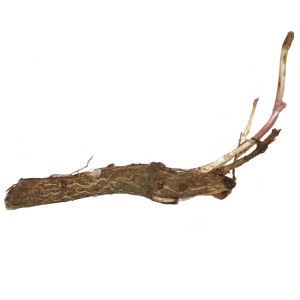
Example of a rhizome
Source: https://lameute.beer/produit/plan-de-houblon-en-pot/
The steps to create a new brewing variety
Create the new plant
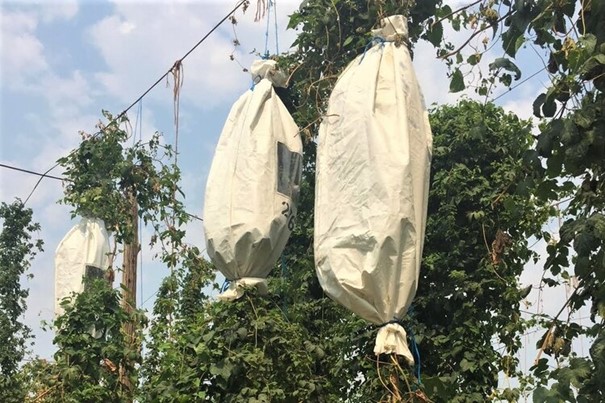
A new variety of brewing hops is created by crossing a female hop plant (often a known brewing variety) with a male plant that possesses a desired characteristic (high alpha acid content, high HSI*, favorable yield, etc.). When the female flowers emerge, they are bagged to trap the airborne pollen. Pollen from the male flowers is then applied to these female flowers to stimulate the production of new seeds. These seeds are then planted in greenhouses to germinate.
* preservation and storage capacity.
Source: https://www.beervanablog.com/beervana/2022/6/23/reprise-how-a-hop-earns-its-name
A little bit of science:
Hop plants exhibit a high level of heterozygosity , which measures genetic variance. Diploid organisms possess two copies of each gene. Each of these copies is called an allele. If an organism has two different alleles for a gene, it is heterozygous for that gene. If the organism has two identical alleles at that locus, it is homozygous.
Hops are heterozygous in that each seed contains a new mix of alleles. And, although all the plants are obviously of the same hop variety, each one is a unique variety of that hop. Thus, if you cross a Cascade female with a male (even one with Cascade genetic material), none of the seeds will produce a Cascade plant.
Plant evaluation
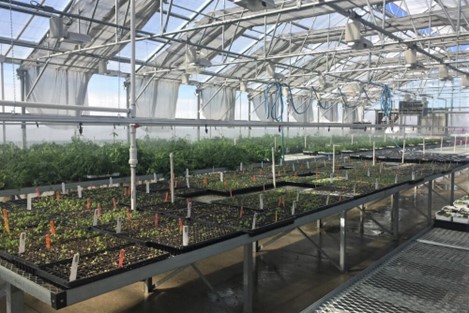
In the first year, these plants are grown in greenhouses. Any with agronomic defects are discarded, and those that are viable are then moved outdoors. Two years of outdoor growth are required to assess their yield, disease resistance, and other factors. Their brewing potential is also evaluated, including alpha acid content and oil composition.
Source: https://www.beervanablog.com/beervana/2022/6/23/reprise-how-a-hop-earns-its-name
Evaluation of clones
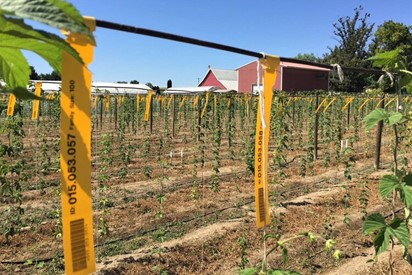
The rhizomes of validated plants are divided to produce between 15 and 30 clones. Once each clone reaches maturity, it is re-evaluated to ensure that the seedling’s performance is consistent across all conditions and that each plant exhibits the same characteristics. The analysis of these properties is continuous, and the best-performing seedlings are then cultivated on increasingly larger plots.
Source: https://www.beervanablog.com/beervana/2022/6/23/reprise-how-a-hop-earns-its-name
Commercial-scale trials
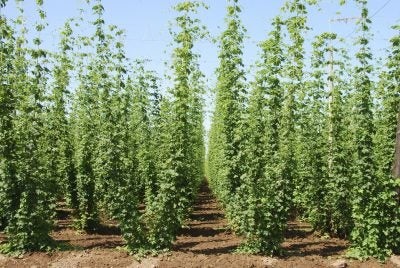
Having reached the final stage, certain cultivars are finally planted on a plot of approximately two hectares. This plot must be able to produce enough hops to fill the bottom of a hop drying kiln. The producer then goes through the process of harvesting, separating the cones, drying, and packaging to see if the hops are compatible with commercial-scale machinery and packaging. Brewing tests can already be conducted. If everything is successful, the producer then decides whether to market this cultivar*.
* Note: To stand out in a market saturated with new hop trials and varieties, each cultivar must possess distinct characteristics that make it stand out in a catalog. This can be achieved through aromas, yield, alpha acid content, storage capacity, etc.
Source: https://www.gardeningknowhow.com/edible/vegetables/hops/plant-spacing-for-hops.htm
An experimental hop
The best-known example of variety creation is the Hop Breeding Company, a company working with both Yakima Chief Ranches and Barth Haas*, which produces the experimental hops known as HBCs (the company’s initials followed by a batch number). For example, Citra was originally HBC 394, Sabro HBC 438, and Mosaic HBC 369… Hence the value of highlighting the experimental hops used in certain beers; they can become stars! 😉
*Jason Perrault of Yakima Chief and Michael Ferguson of Barth Haas are the two hop growers who closely oversee this program.
When hops begin to be marketed under the name HBC, it implies that their cultivation has been validated and is being used commercially, but that they are still in the experimental phase in the brewing market. Indeed, at this stage, it is necessary to validate the hops’ suitability for the brewing industry and their long-term viability. The variety will obtain its official name after a few years of commercialization, once its suitability and characteristics have been tested and approved in the field.
Thus, between the production of an initial plant and its commercialization, a decade can easily pass, and each clone of a plant can reach tens of thousands…
It should be noted that for each new commercially available variety, hundreds of semi-hybrids have not been selected.
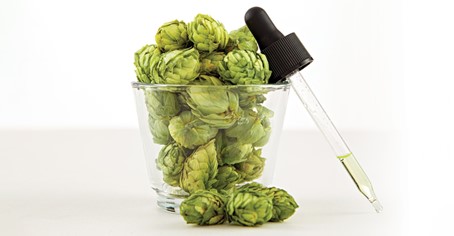
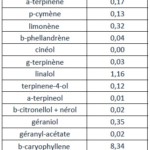
Source: https://beerandbrewing.com/terpenes-brewing-with-the-essence-of-hops/
The next time you enjoy a pint of your IPA with a new hop, you’ll know that it took years of testing, rejections, and improvements to achieve this aromatic result!
SOURCES
https://beerandbrewing.com/dictionary/zIlgUHefML/
http://www.bruharoo.com/creating-new-hop-varieties-take-time/
https://www.beervanablog.com/beervana/2022/6/23/reprise-how-a-hop-earns-its-name
https://www.brewersassociation.org/programs/hop-breeding-program/