
Hop harvesting, from the 20th century to the present day (practices, machinery, techniques, etc.)

Article written in collaboration with Alexandra Berry .
Origins of hop cultivation
Hops have been cultivated since around 200 AD in Babylon, and the earliest written records of hop harvesting date back to 859. Records of hop cultivation have been found in 1348 in Žatec (now known for the cultivation of Saaz hops).*
*The first written mention of hops as an ingredient in beer dates back to the 12th century – thanks to the research and writings of Abbess Hildegard von Bingen. In her natural encyclopedia, Physica Sacra , she cataloged medicinal plants and their properties, with a particular fondness for hops.
Emperor Charles IV (1316-1378), Holy Roman Emperor, greatly promoted hop cultivation through a royal decree and a ban on the export of Bohemian varieties, which were already sought after by brewers. In 1538, Prince Christoph von Pappenheim of Eichstatt, a small principality in present-day Bavaria, awarded the very first hop seal and certificate to the town of Spalt, south of Nuremberg. Other surrounding principalities, such as Žatec and Plattau, subsequently received the same honor. These seals guaranteed that the hops originated from the designated region and became one of the earliest examples of the hop appellations we know today.
In the 14th century, the regions of Flanders and Bohemia were the main sources of hops for beers produced in Europe.
The English Hop Harvest
These varieties were imported into England as early as the 1400s, but were still considered illicit additions by local brewers (the addition of hops to beer was even banned in Norwich in 1471). They were imported from France, Holland, and Germany. It wasn’t until 1524 that the first hop plants appeared in southeast England, specifically in Kent. With its ideal terroir for this plant (rich soils and ample irrigation), the region was also prolific in timber and coal, allowing for the construction of numerous hop drying sheds*.
Initially, Flemish Red Bines hops were planted, but they did not adapt to the English climate and soil. Therefore, new varieties were created through crossbreeding. Towards the end of the 18th century, Whitebines were replaced by Goldings . By the beginning of the 19th century, this hop was distributed throughout England, becoming, along with Fuggle , the flagship of English hops .
The 19th century was the golden age for the hop industry, with hop fields expanding across the country to reach 77,000 hectares of cultivation by 1878. The popularization of Pale Ale and India Pale Ale greatly contributed to encouraging this agriculture.
Pasteurization (requiring less hops to preserve beer), the importation of international varieties, and the rise of lagers would undermine this growth. By 1909, only 32,000 hectares of hop fields remained across the country.
Barely 23 years later, only 16,500 hectares of production remain, confined to the West Midlands and South Eastern regions of England. These regions have become the heartland of the harvest, attracting crowds of farmers for a few months each year who come to participate in the harvests.
The United States: the El Dorado of hops
Hop cultivation spread to America in the 16th century through crossbreeding various known and native varieties to adapt to different soil types. Initially imported from England, the Massachusetts Bay Colony ordered seeds and plants in 1629 to establish local hop farming. The first commercial transactions involving American varieties date back to 1648 for a brewery in Massachusetts. This state remained the largest supplier of hops for 150 years. Hop farms spread throughout the surrounding states of New England (Maine, Vermont, New Hampshire, Massachusetts, Connecticut, and Rhode Island).*
* These abundant hops and the craft beer revival in the United States led to the creation of the New England IPA at The Alchemist, the famous Heady Topper. To read more about it, click here .
The climate, fertile soil, and regular irrigation of the northeastern United States, along with the region’s farming heritage, favor the development and yield of hop farms. Beginning in the 1890s, many of these were established in the Yakima Valley region, known for its hot, dry summers and abundant, regular irrigation (thanks to the river of the same name), ideal for hop cultivation*.
*Towards the end of the 19th century, approximately 12,000 farmers and agricultural workers were required to complete the annual harvest.
Hop Cultivation Techniques
How to grow your own hops?
The hop plant follows the same life cycle every year. In March, hop growers attach the hop vines to metal supports connected by natural coconut fiber ropes so they can grow upwards and proliferate. The spacing between each support is precisely measured according to the variety.
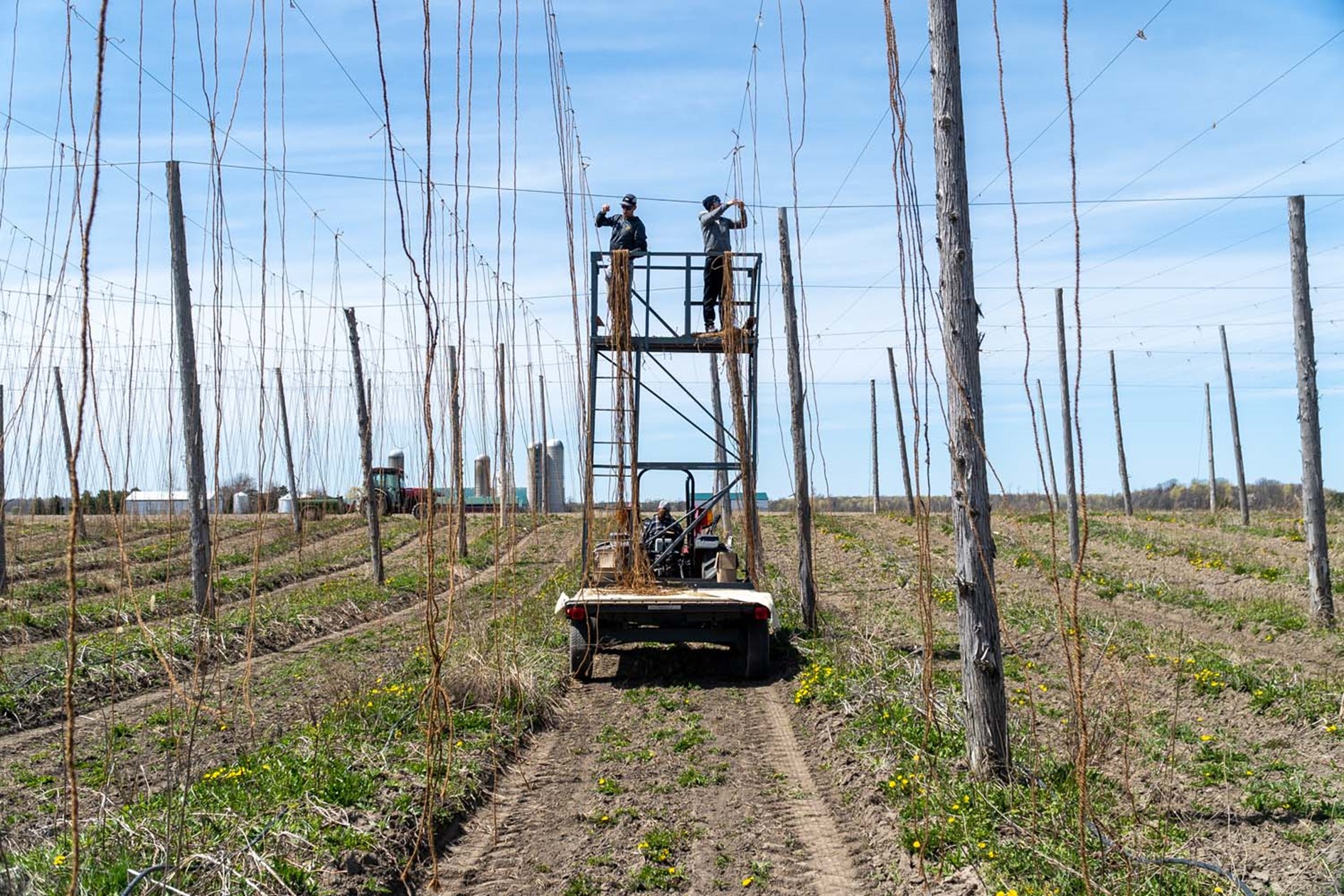
This crossing of ropes follows a regular pattern designed to optimize yield and harvest according to the hop variety and can exceed 6 meters in height.
Budding typically begins in early April. At this time, the hops are tied to strings, sometimes up to two or three vines on a single string; this is called “training.” This practice is still done by hand. Starting in the spring, irrigation or watering of the hop fields begins and is very closely monitored.
By June, most of the plants have grown and, secured to their supports, begin their growth and flowering. Around mid-July, the hop plants have reached their maximum height and begin to unfurl. The first inflorescences, then cones, develop. During the summer season, hop growers must be very vigilant against potential infections or pests that could damage the cones and destroy an entire hop field in a matter of days. Hailstorms are also extremely devastating.
Next comes the moment to determine when the cones are ready to be harvested! Even though they give off a strong aroma, attention must be paid to the cone’s moisture content to avoid harvesting too early or too late. Hop growers closely monitor their hops from mid-August onwards to ensure they don’t miss the optimal window.
https://www.magneticmag.com/2018/10/celebrating-oregons-annual-hop-harvest-in-portland/
When to harvest your hops?
The hop plant is very resistant to harsh weather and climate, and its extracts create an environment hostile to microorganisms, protecting the flowers against most infections. This also explains hops’ preservative properties in beer. The only bacteria that manages to survive is yeast, making hops the ideal flavoring agent for brewing.
There is no specific recommended date for planting hops; this depends on the hop yard’s location, soil type, weather conditions, and cultivar. Generally, the harvest begins around the end of August and can last until October. In this respect, some varieties are considered ” early ” (Tettnang, Saphir, Styrian Gold, etc.), ” mid-season ” (Cascade, Amarillo®, Perle, etc.), or ” late ” (Spalter Select).
Hop growers determine the ideal harvest time primarily by observing the cones. The first approach is empirical, based on the grower’s experience and expertise: the cone must be rubbed in the hands to assess the leaf’s maturity and extract the lupulin. The leaf tips may be slightly reddish or beginning to open, revealing the dark yellow lupulin. The cones, firm, squish easily in the hands and release a characteristic resinous aroma.
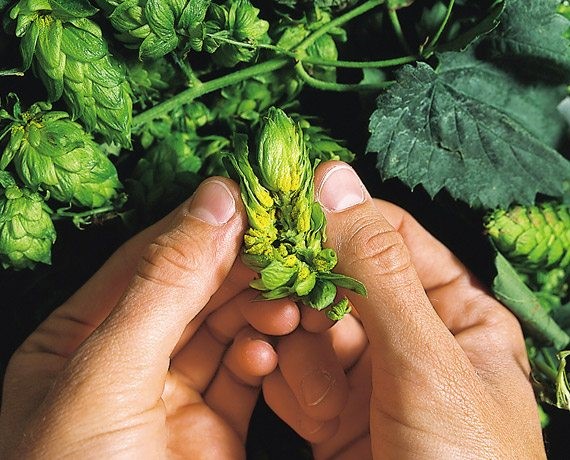
The second method relies on laboratory analysis to control the cone’s moisture content, which should be around 80%. This is done by taking a sample, which is then dried. The hop grower can then compare the weight of the dried cone to that of the fresh cone to determine its moisture content.
A 2011 study conducted at Oregon State University shows that the composition of essential oils in hops varies depending on their harvest date. The analyses support the idea that the intensity and quality of aromas increase if hops are harvested later. However, be careful not to wait too long, because excessive ripeness, while beneficial for the plant’s “storage” (meaning the reserves the plant will build up before winter and for the next season), is much less so for the organoleptic properties of the hops. The right harvest time also allows the producer optimal planning – harvesting/drying/baling – for their different varieties. In short, harvesting hops properly is a delicate balance of experience, science, and management!
The evolution of the hop harvest
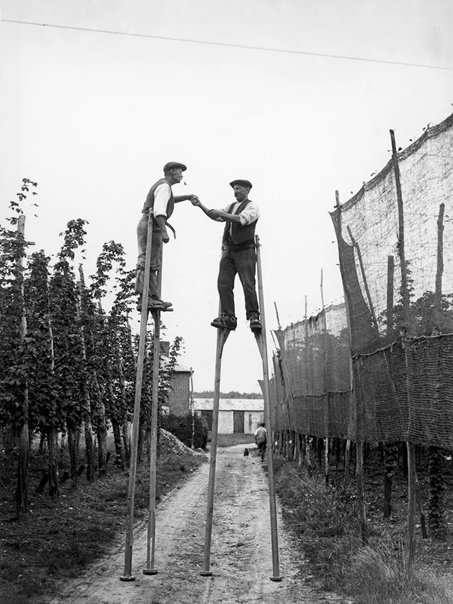
Before the mechanization of harvesting – which we’ll discuss later – it was done by hand. It was (and still is for some farmers!) an exhausting and time-consuming job. The hop vines are cut so that the cones can then be detached, one by one.
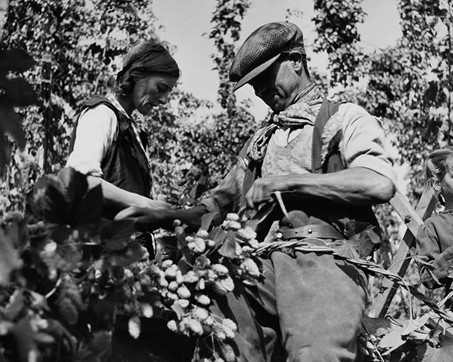
https://rarehistoricalphotos.com/hop-pickers-kent-old-photos/
Historically, farmers recruited en masse for this harvest season, a sociological phenomenon that strongly influenced agricultural life in England, for example. Indeed, Kent has been a region prolific in hop cultivation for centuries, and during the 19th century , it experienced a large influx of families from major industrial cities across the country (primarily London and Birmingham) who came to work during the harvest. These families would stay for periods ranging from three weeks to two months.
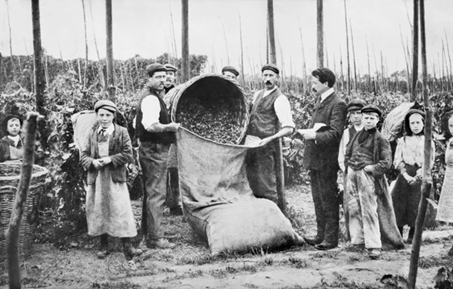
https://rarehistoricalphotos.com/hop-pickers-kent-old-photos/
This agricultural activity grew so large that it even developed its own currency to pay the farmers. The coins were stamped with small illustrations of hops and were specific to each producer/farm.
In 1922, the first hop harvesting machine was imported from the United States for use by a hop grower in Worcester. Mechanical harvesting became more widespread from the 1950s onwards, initially taking hold in the West Midlands. The first English mechanical harvester was developed in 1934.
Since the 1950s, mechanical harvesting has intensified, but hop production remains a highly labor-intensive activity. Hop farms, wherever they are located in the world, rely on seasonal workers for tasks such as stringing and harvesting. Because some operations cannot be done with machines, hops farming remains a story of men and women 😉
The “Hopper Huts” which housed seasonal workers, sometimes in truly unsanitary conditions, were destroyed or restored into modern houses or even transformed into museums.
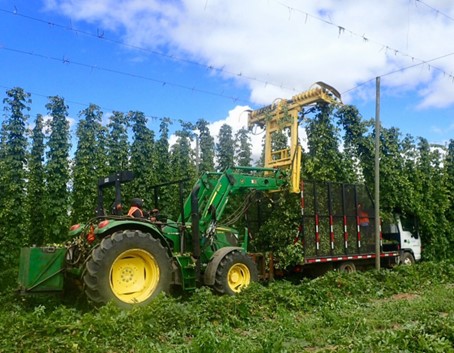
The machines in question have arms that grasp and draw the hop vines into the system where the cones are detached from their supports. These cones are then separated from the vines and leaves, which are subsequently composted. Capable of sorting two to three vines per minute, rather than one per hour manually, these machines have revolutionized the harvesting process. These sorting units can be mobile, allowing for sorting within hop fields. They can also separate the hops from the foliage.
One machine made it possible to replace a hundred farmers and reduced labor time by 90% and production costs by at least 20%.
*Farm size has increased considerably. In the United States, in the states of Washington and Oregon, some farms have grown from an average of 400 hectares to 6,000 hectares today. American farms are significantly larger than anywhere else in the world.
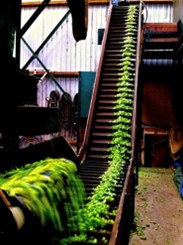
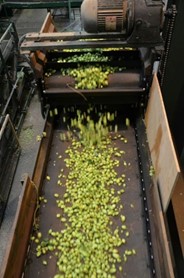
https://stocksfarm.net/the-harvest-workshorse-the-bruff-hop-picker/
The hop harvest is a tradition still celebrated in some places today. In England and Germany, some towns are transformed for the harvest , with hops hanging everywhere and adorning shop windows, brass bands playing, and residents gathering to harvest the fresh hops together. Some breweries in France now produce their own Fresh Hop Beer annually, using hops brewed on the day of their harvest.

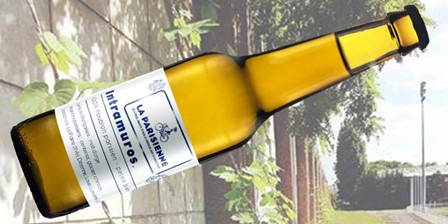
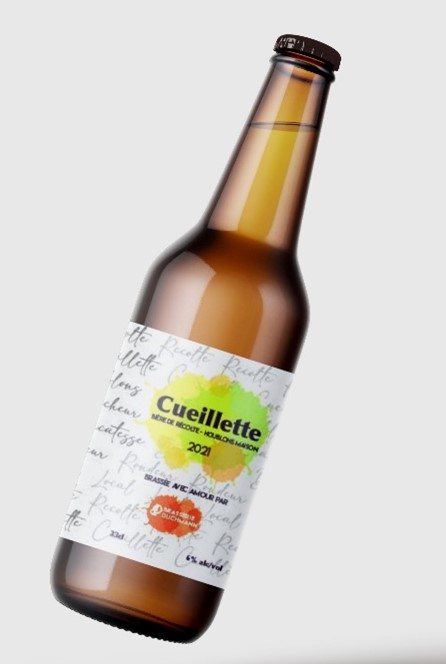
Deck & Donohue’s Strisselspalt, La Parisienne and its Intramuros, the Cueillette from the Duchmann brewery
The De Ranke brewery has created its Hop Harvest, a beer brewed with hops grown that very day, promoted under the name “Beaujolais of beer.” To be enjoyed worldwide on the third Thursday of November, just like Beaujolais wine, this celebration honors hops, but also the craftsmanship, culture, and forgotten traditions of the style.
A tradition to pass on and celebrate
Historically a celebrated and communal event, the mechanization of hop harvesting has nonetheless contributed to the decline of tradition and the ceremonial aspects that accompanied the harvest season. While increasing yields by reducing production costs has led some farmers and brewers to return to the roots of tradition with occasional, festive, manual harvests. Harvest Ales are a reminder of the brewers’ historical tradition of crafting unique beers with fresh hops.
Just like Beaujolais Nouveau in November, let’s celebrate these hop harvests annually, allowing us to savor our favorite beers! Don’t hesitate to inquire to find out which breweries, farms, or hop farms still organize manual harvests each year.
SOURCES:
Berry, A., (R)Evolution and Craftsmanship in the Service of Beer , (2021) Editions Baudelaire.
https://rarehistoricalphotos.com/hop-pickers-kent-old-photos/
https://americanhopmuseum.org/history
http://www.britishhops.org.uk/
https://backroadshops.com/
https://www.oregonencyclopedia.org/articles/hop_industry/#.Y0-hKXZBy3A