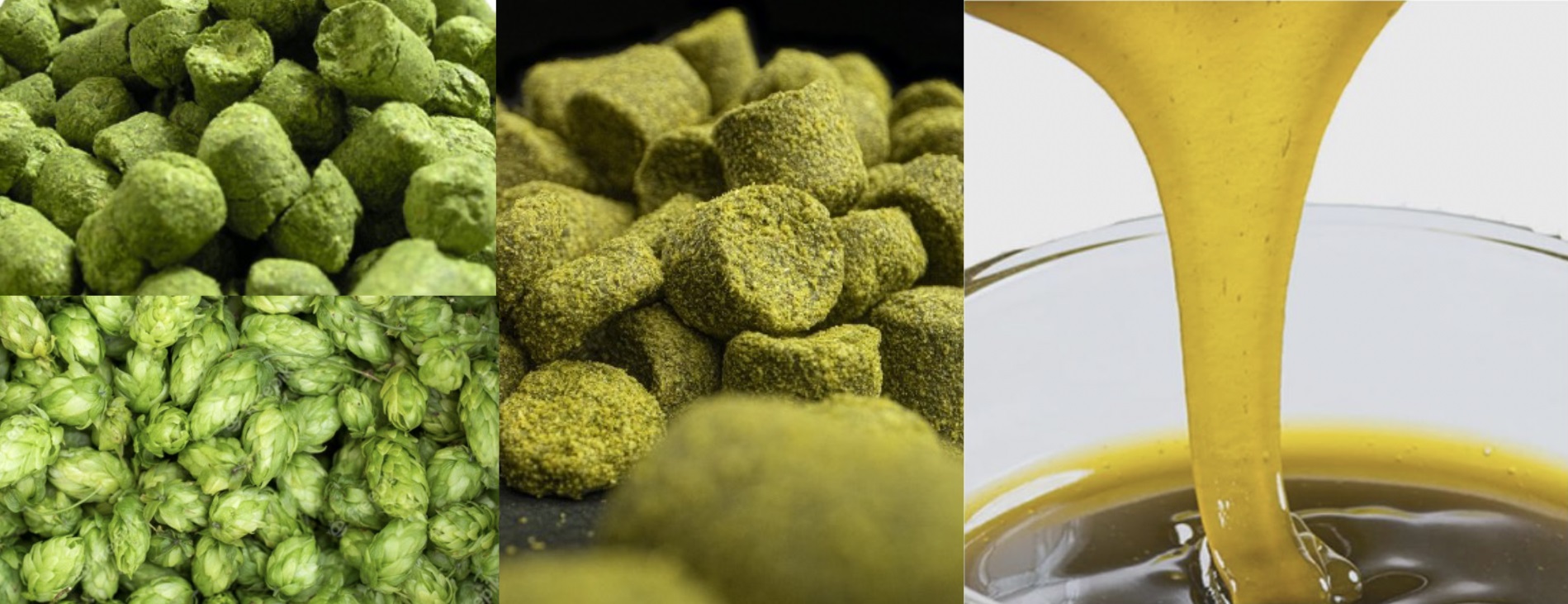

“Put some oil…” in the hops!

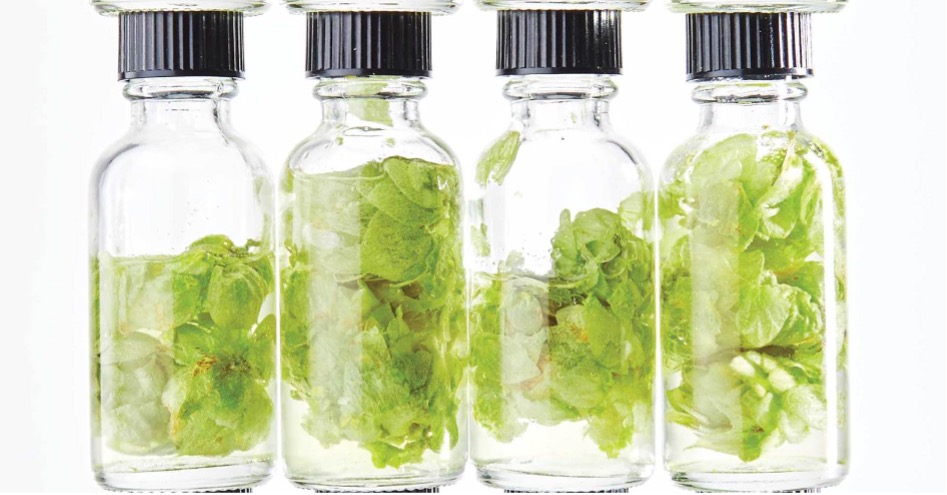
Article written in collaboration with Alexandra Berry.
Overview
A hop cone is composed of:
- 40 to 50% cellulose,
- 15% protein,
- 10% water and
- between 2 and 20% alpha acids
- up to 3% essential oils
However, although they represent only 1 to 3% of the plant’s composition, essential oils are a key focus for brewers. Alongside the resin and alpha acids in hops that give them bitterness, essential oils contribute to the full range of flavors you find in your glass . While alpha acids isomerize during boiling to produce bitterness , it is the oils that create the citrus, pine, or tropical fruit notes, lending beer its complexity and diversity.
Hops also contain minerals, pectins, sugars, proteins, polyphenols, lipids… all contributing to bitterness, aromatization, foam retention, preservation or even the lifespan of hops.
Although oils are only one of the weakest components of the cone, they are also one of the most important and impactful for the flavoring of a beer.
A bit of history
These chemical components were isolated nearly 200 years ago, and it was Alfred Chapman who named them towards the end of the 19th century. However, it wasn’t until the invention of gas chromatography in 1950 that the 1,000 chemical compounds in hops could be identified.
By exploring hop research, scientists—and now brewers—can identify certain components through a hop’s aroma: citronellol is very green, floral, and citrusy; geraniol is very floral and reminiscent of geranium (hence its name); linalool is rather “orange”… and yet, the difficulty arises when these components interact with others, such as the wort, other hops, yeast, or simply when they are transformed by heat. Research continues in this area to more precisely identify these compounds and their chemical transformations in order to help brewers better control the flavoring of their brews.
Moreover, some scientists hypothesize that rather than analyzing the chemical compounds of hops, which will always be variable, it would be better to understand and know how to control the interactions of these components with other variables in the brewing process.
Caution…fragile oils!
In the anatomy of the hop cone, the so-called volatile oils represent only a maximum of 3% of the cone’s weight.
It may not seem like much, but since these oils are very concentrated, very little is needed to flavor a beer.
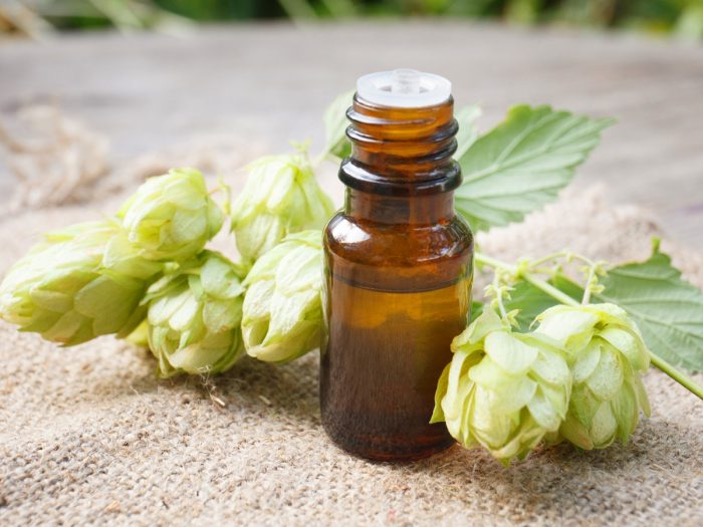
It should also be noted that these oils are much more delicate than the bittering components contained in resin. The composition of hop oils will largely depend on the variety, but will nevertheless be based on hydrocarbons (between 50 and 80%), which are very volatile and poorly soluble. A particularly aromatic hop, rich in essential oils, will therefore be selected for dry hopping, added at the end of the boil. They can also be added during fermentation to enhance certain desired aromas.
It is also because of this fragility that hops must be kept cool and protected from oxygen; oxidation can occur very quickly once harvested. This vulnerability contributes to the success of ” wet-hopped ” or ” fresh-hopped ” beers, brewed with freshly harvested cones.
What are the different hop oils and their characteristics?
Hops contain several types of oils, the proportions and characteristics of which will depend on the hop variety and its terroir. Below are the four main oils you can find in your beers:
Myrcene, approximately 50% for hops with the highest concentration
Myrcene is the dominant oil in hops, generally making up more than 50% of the oils in the cone. This oil, in particular, is very sensitive to heat, and heating it too much or for too long will certainly destroy the aromas of hops that contain a high concentration of it.
Longer boils will give you aromas of pine and citrus; shorter boils will frankly enhance the citrus and fruity side, with peeled orange being something that comes through quite frequently.
Hops containing 40 to 50% are considered to have a high myrcene content; so-called “noble” hops (especially European ones) contain around 10 to 25%.
Here are some hops that contain high levels of myrcene oil:
- Yellow
- Cascade
- Callista
- Styrian Fox
- Crystal
- Calicross
- Horizon
- Orion
- Riwaka
- Simcoe
Myrcene is also found in ginger and ginseng.
Humulene, approximately 20%
Humulene is the second most common oil found in hops, sometimes even more concentrated than myrcene. It imparts herbaceous, woody characteristics to the hops. It is also more heat-resistant than myrcene and works very well at the end of the boil. If you let it boil longer, it will bring out spicy notes. Some have compared its aromas to those of coriander or white pepper… worth checking out 😉
Hops containing more than 29% humulene will be considered to have a high level of this oil.
Here are some hops that contain high levels of myrcene oil:
Caryophyllene, approximately 8%
Although found in small quantities, caryophyllene offers distinctive woody and herbal aromas and greatly contributes to herbaceous beers; it is quite similar to humulene in terms of the aromas it imparts. The peppery notes of this oil make it a natural insect repellent.
New Zealand and Australian hops contain the least; hops with a level above 15% will be considered to have a lot of Caryophyllene.
Here are some hops that contain high levels of myrcene oil:
It is found in black pepper and cloves.
Farnesene, approximately 6%
This component often represents less than 1% of the oils, although for some varieties it can reach up to 10%. It is recognized for its woody characteristics and is well represented by Czech Saaz or Tettnang .
The remaining oils represent minute quantities but can still play a role:
- Linalool offers floral aromas like lavender and citrus;
- citronellol is (as its name suggests) very citrus-like;
- Pinene contains aromas of pine, sage, rosemary and resin.
Oxygenated hydrocarbons are more soluble and aromatic. Their aromas, or those resulting from the fermentation process, will be clearer in a finished brew. These include linalool, geraniol, citronellol, etc. And yet, this hydrocarbon will still only make up a maximum of 1% of the hop oil.
Sulfur compounds (also called thiols) can also be found in minute proportions in these oils. Even in very small quantities, they are easily detectable and can greatly influence the aromatic perception of hops. They are difficult to measure because they are much less abundant than hydrocarbons and require very precise and expensive equipment to detect. And yet, they can impart aromas of passion fruit, tropical fruits, Sauvignon Blanc, or other exotic aromas that can be found in Citra, Mosaic, and New Zealand hops .
In addition to the analyses (which are not systematically carried out at this level of detail for each harvest and variety), it is possible to infuse the hop cones to get an idea of the main aromas that your hops will bring.
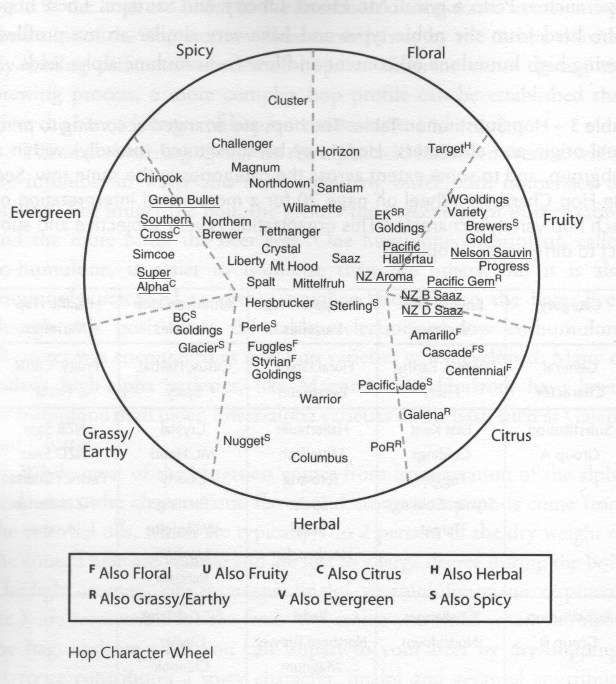
Although there are obviously variations depending on the terroir, the year, etc., and this tool is not exhaustive, one can still get an idea of the aromatic profile of a hop by consulting John Palmer’s Hop Wheel :
How to measure and dose hop oils?
Hop oil is extracted by evaporating 100 grams of hops for 3 to 4 hours. The oil is then measured in milliliters, for example:
1ml of oil extracted from 100g of hops = 1ml/100g = 1% hop oil
This measurement is useful for calculating the flavoring of a brew, particularly when brewing with a cone. For example, for a late addition of hops to the brew:
2 ml/hl for 10 hl = 20 ml of oil required
20 ml ÷1 ml ×100 g= 2000 g of hops
For dry hopping:
4 ml/hl for 10 hl = 40 ml of oil required
40 ml ÷1 ml ×100 g= 4000 g of hops
These calculations will obviously depend on the recipe and the desired style, but give an idea of the hop ratio required to obtain flavoring in the brew.
Infinite variables
Although the composition of hops can be made available to brewers, this will not be a guarantee of the taste that will be imparted to the beer.
The Wye Hops Institute in England has shown that the same variety of Cascade, with the same chemical composition, will not produce the same sensory experience: the oils were the same but did not have the same taste perception (!)
Thus, the aromatic profile of hops depends not only on their chemical composition and interaction with the brewing process, but also on the concentration of aromas in the essential oil and how these aromas are perceived. For example, thiols, when present in low concentrations, offer very fruity and exotic aromas, while in high concentrations, these aromas can be reminiscent of cat urine.
Furthermore, by blending several hops at different concentrations, synergies can occur between these different components to create something completely different, masking or highlighting certain aromas and flavors. It’s often the thiols that divide beer lovers: some detect beautiful aromas of blackcurrant or wild berries, while others perceive aromas reminiscent of cat urine.
Terpenes
Terpenes are increasingly used by brewers for the precise flavoring they allow. Terpenes are highly concentrated extracts of all the oils present in hops. While relatively expensive, they pay for themselves because very little is needed to flavor or bitter a brew, unlike hop cones, for example. Furthermore, these extracts are precisely analyzed and measured, which simplifies recipe development by allowing for precise control of boiling times and temperatures, thus enabling the calculation of the final flavor profile and the exact IBU of a beer.
According to various brewers, terpenes also impart greener, more “danky” aromas to beer. Exotic fruits and citrus fruits are more pronounced because they are more concentrated.
10 Essential Oils to Recognize by Their Aromas:
- caryophyllene: woody
- citronellol: citrus, fruity
- Farnesene: floral
- geraniol: floral, rose, geranium
- humulene: wooded, pine
- limonene: citrus fruits, orange
- linalool: floral, orange
- myrcene: green, resinous, pine
- nerol: rose, citrus
- pinene: spicy, pine
Beyond their aromatic properties, we will discover in a future article all the virtues that these essential oils of hops possess.
Stay tuned 😉
Sources:
- Hombrewing
- Barth Haas
- Beerandbrewing
- Extraction magazine
- Naturally inspired
- Woodske D., Hop Variety Handbook, 2013