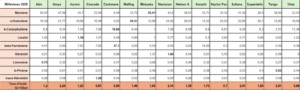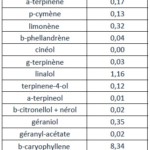
15 aromatic varieties examined under the microscope
As we have mentioned on this page , the main aromatic compounds of hops are Terpenic Hydrocarbons (50 to 80% of the oils) and Oxygenated Compounds (20 to 50% of the oils).
Gas chromatography coupled with a flame ionization detector (GC-FID) makes it possible to identify these main elements in hop pellets.
Analyses were therefore carried out on 15 samples of aromatic hops in April 2026.
Here is the table that summarizes all the analyses:
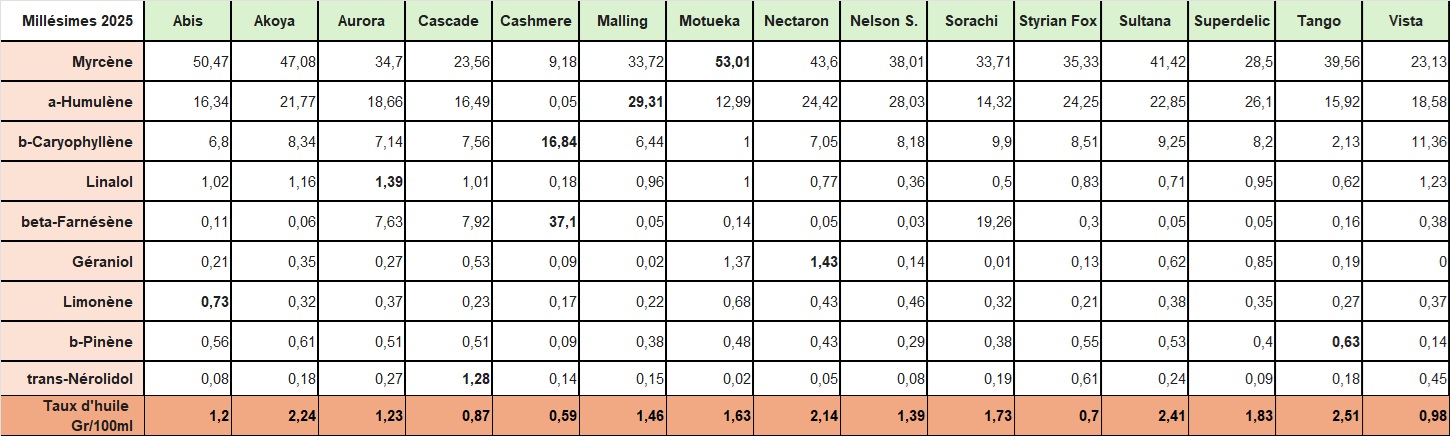
(As we discuss here , there are ways to boost the results. Here we analyzed the pellets after several months of storage, so we are as close as possible to the true taste of each hop variety. This contrasts with an analysis of a few selected and over-dried cones…)
Here is the resulting spider chart: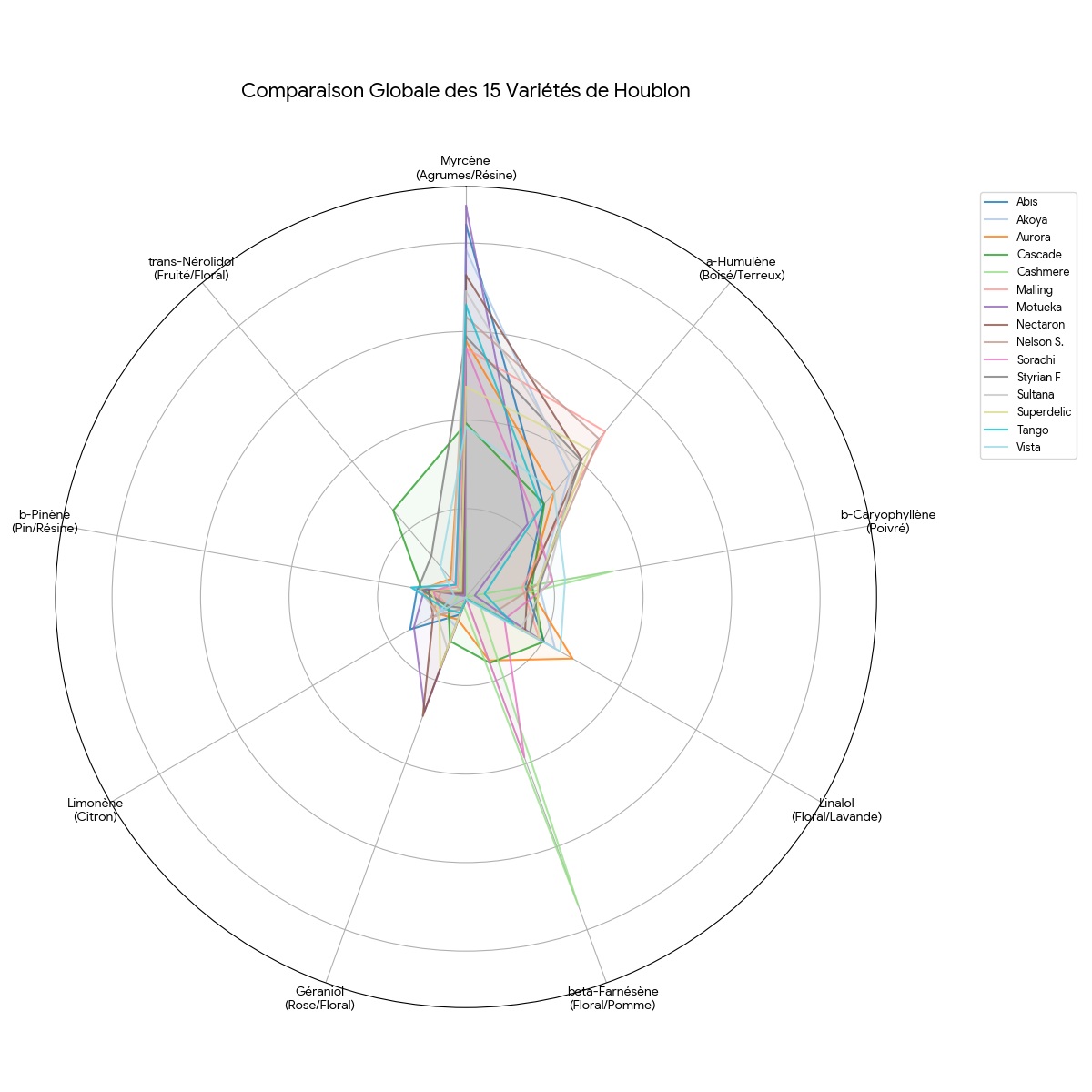
It is difficult to distinguish them as certain compounds are present in all varieties!
Indeed, Myrcene and Humulene stand out in the 14 hops in a predominant way, largely overshadowing the others whose quantities are too small to appear.
To improve their visibility, a dual-scale system has been implemented, but perhaps 3 or 4 scales would be needed to reveal certain compounds… Note that even if they are in small quantities, they can be expressed in beer.
By reversing the axes, we can better identify the champions in each category:
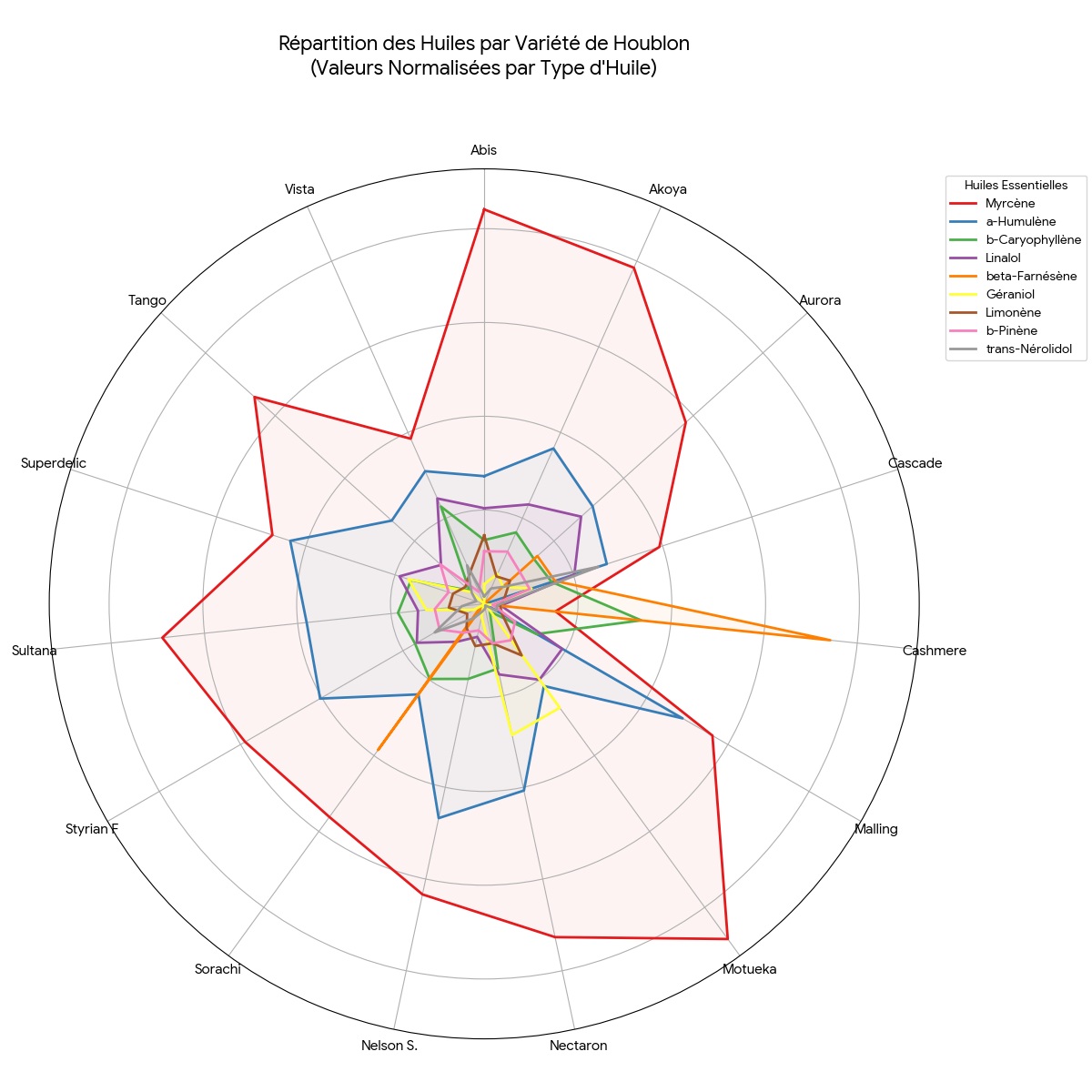
So what aromatic profiles have been identified?
| Aromatic Family | Chemical Characteristics | Hop Varieties | Sensory Profile & Key Notes |
| CITRUS & RESINOUS TREES | Very high level of Myrcene (> 45%) | Motueka , Abis , Akoya , Tango | Lime zest, pink grapefruit, fresh pine resin, herbaceous freshness. |
| TROPICAL & FLORAL | Rich in Geraniol , Linalool and Nerolidol | Nectaron , Sultana , Cascade , Aurora , Superdelic | Ripe pineapple, passion fruit, rose petal, lavender, fruit candy. |
| THE NOBLE & SPICY | Alpha dominant – Humulene (> 25%) | Malling , Nelson Sauvin , Styrian Fox | Earthy, dried grass, precious wood, white pepper, notes of Sauvignon Blanc. |
| THE ATYPICAL & EXOTIC | Rare profiles (high Farnesene or Caryophyllene ) | Cashmere , Sorachi Ace , Vista | Lemongrass, melon, green apple, cedarwood, creamy texture. |
Which combinations work well?
| Beer Style | Recommended Association | Objective of the Assembly | Why does it work? |
| NEIPA / Hazy IPA | Nectaron + Cashmere | Tropical fruit bomb and silky texture. | The Geraniol from Nectaron (1.43%) bursts into pineapple, while the Farnesene from Cashmere (37.1%) brings sweetness and melon. |
| West Coast IPA | Motueka + Tango + Cascade | Sharp, resinous and lemony profile. | Motueka gives the citrus “punch”, Tango brings the forest (Pinene) and Cascade ties it all together with its floral/grapefruit. |
| Modern Pilsner / Lager | Malling + Akoya | Noble finesse with a modern “twist”. | Humulene from Malling provides the earthy/herbaceous side, Akoya brings a delicate floral touch (Linalool). |
| Season / Farmhouse | Nelson Sauvin + Aurora | White wine, spices and floral elegance. | Nelson Sauvin lends its grape/redcurrant notes to the beer, while Aurora complements it with high linalool for floral roundness. |
| Fruit / Sour Beer | Abis + Sorachi Ace | Lemon sorbet with exotic notes. | Abis is the king of Limonene (pure lemon), Sorachi Ace brings the floral complexity that magnifies the acidity. |
| Black IPA / Stout | Vista + Sultana | Balance between the peppery grain and the fruit. | Vista brings Caryophyllene (pepper/cedar) which blends with roasted malts, Sultana adds a contrasting pineapple/resin touch. |
Any other associations that work well?
| NEIPA / Hazy IPA | Nectaron + Superdelic + Cashmere | Peach, passion fruit, red fruit candy and silky texture. |
| West Coast IPA | Akoya + Sultana + Cascade | Powerful resinous pine, grapefruit and precious wood in the background. |
| Modern Pilsner | Malling + Aurora | Pure woody notes, lavender and white flowers (bergamot). |
| Season / Farmhouse | Vista + Styrian Fox | Black pepper, spices and elderflowers. |
| Wheat Beer (White) | Cashmere + Sorachi Ace | Green apple, melon and sweetness. |
| Modern Pale Ale | Motueka + Nelson Sauvin | Explosive lime and notes of Sauvignon Blanc grapes. |
| Double IPA | Nectaron + Akoya + Sultana | Ripe exotic fruits on a sticky resin base. |
| Black IPA / Stout | Vista + Malling | Pepper and noble woodiness highlight the roasted malts. |
=> To add to this, you can find the article we wrote on hop blends here: Part 1 and Part 2
What other factors should be considered when evaluating the aromatic potential of a hop?
Total Oil Content (mL/100g)
GC/FID analysis gives the percentage breakdown of the components (the proportion of each oil in the mixture), but it does not tell what total amount of oil the pellet contains.
-
Why this makes all the difference: Imagine two hops with 50% Myrcene. The first has 1 mL of total oil per 100g, the second has 3 mL. At the same dosage (e.g., 5g/L), the second will be three times more aromatic .
-
The benefit for the brewer: A high total oil content (e.g.> 2.0 mL/100g) allows you to reduce the amount of plant material in the fermenter (less “sludge” and less beer loss) for the same aromatic impact.
=> We’ve written an article about oils; you can find it here.
Thiols: The Hidden Side of Aromatic Herbs
Thiols are sulfur compounds present in minute quantities (nanograms per liter), so small that they don’t appear on conventional chromatography, but our nose is thousands of times more sensitive to them than to terpenes (Myrcene, etc.). They represent less than 1% of aromatic compounds, yet they play a fundamental role in the aroma of a beer, and therefore its taste.
We conducted tests last year (through several collaborations) which confirmed this impression: it is possible to make good IPAs without using hops from far away . However, the main difference is noticeable (and that’s putting it mildly) in the flavors: the aroma.
These NZ and US hops are distinguished by their -thiols (free and conjugated) which are readily and quickly available from the first grams.
This means it’s entirely possible to make a very good IPA using a minimum of New Zealand and US hops . Our collaborations this year should prove it.
Further work is also possible on biotransformation and water profile to improve these results even further. We’ll discuss this again soon.
Indeed, some European hops contain quantities of thiols and precursors that are underestimated.
The main difficulty is that the search for thiols requires a much more complex technology (GC-MS/MS) because it is necessary to detect minute traces in the middle of an ocean of other molecules.
The Hop Deterioration Index (HSI)
This is the most crucial analytical data after the oils. HSI measures the oxidation of alpha and beta acids; the lower it is, the better.
-
Interpretation: An HSI close to 0.25-0.30 indicates very fresh hops. If it exceeds 0.50 , the hops are old or have been improperly stored and can only be used for dry hopping.
-
Aromatic impact: A high HSI means that your oils (Linalool, Myrcene) are degrading into oxidation compounds (like isovaleric acid), bringing notes of cheese or old feet, even if the Myrcene level still looks okay on paper.
Alpha (AA) and Beta (BA) Acid Levels
Even if you are looking for aromatics, the ratio between these two is fundamental.
-
The AA/BA ratio: The closer this ratio is to 1:1 , the more “fine” the bitterness is considered and the more stable the potential for preserving aromas over time.
-
Co-humulone: Expressed as a percentage of alpha acids. A low level (< 25%) is often associated with a milder bitterness which allows delicate oils like Linalool to express themselves more fully.
The Physical Qualities of Pellets
The visual and tactile appearance of the pellet tells you a lot about the work of the processor:
-
Pelletizing temperature: If the pellet is too shiny or “icy,” it may have overheated during pressing. This destroys the most volatile oils (Myrcene) before you even open the bag.
-
Density and friability: A pellet should disintegrate easily in warm water (dissolution test). If it remains as hard as wood, its extraction by dry hopping will be poor, and you will never reach the potentials indicated by chromatography.
=> We’ve written an article about pellets; you can find it here.
Sensory Analysis
Science cannot replace your sense of smell. The Rub Test involves vigorously rubbing a few pellets in the palm of your hands to warm the oils.
-
What to look for: Persistence. Some hops have a strong initial aroma (Myrcene) but the smell disappears after 10 seconds. Great aromatic batches have a scent that lingers on the skin and evolves into more complex notes (fruit, flowers) after 30 seconds.
Polyphenol Content
The pellets contain plant matter (dry matter).
-
The impact: Hops very rich in polyphenols can impart astringency during heavy dry hopping . This is what sometimes creates the “hop burn” (a burning sensation at the back of the throat) in NEIPAs.
-
Note: So-called “Noble” hops (like your Malling or Aurora) often have a very different polyphenol/oil balance than modern “Aroma” varieties.
The Solubility of Oils
Not all oils dissolve in beer in the same way.
-
Hydrophobic Oils (Myrcene): They do not remain in solution easily. They require biotransformation (yeast) or prolonged contact to leave their mark on beer.
-
Hydrophilic Oils (Linalool, Geraniol): These pass very easily into beer. A batch with a high linalool content will always be more effective for aroma than a batch rich solely in myrcene.