
How to choose your hop blending? Part #2

Article written in collaboration with Alexandra Berry
After analyzing the chemical composition of hops , you now have the information you need to choose your varieties for an effective and aromatic blend.
Some rules to remember:
- The blend adds complexity:
Not just in terms of flavor! Combining different hop varieties allows for a play on textures, bitterness, and nuances that you won’t necessarily get with a single hop. By playing with combinations, the possibilities for roundness and flavor are endless!
- It’s not as simple as adding a pinch of salt or pepper…
Indeed, when you add hops, you’ll have an approximate flavor profile in mind. However, as we’ve seen, some hops undergo complete changes during isomerization and can react chemically when in contact with other varieties! For example, if you combine a hop high in myrcene with another, expecting a resinous flavor, you might be disappointed. This myrcene could be completely masked during the brewing process and overpowered by another, much more potent ” residual ” hop. Brewing is certainly a science, but it also involves a lot of testing and tasting to achieve the desired result.
- Be careful not to overdo it.
If you load your beer with too many different varieties, it’s a bit like coloring the same space with lots of different colors: you’ll end up with a sort of brown sludge. Take the time to carefully select 2 or 3 varieties at the beginning to test the combinations and highlight the unique characteristics of each.
- It’s all a matter of time.
Just like in cooking, the timing of adding hops will have a huge impact on the final product. If you’re aiming for a contrasting or complementary flavor profile, it might be wise to add the hop you want to be dominant towards the end of the boil. For a truly harmonious blend, you can create a hop mix before brewing and add both varieties together at various points in the brewing process.
2. Choosing your effect
As with cooking, you should think of blends as pairings. This gives you three possible effects: enhancement, contrast, or complementarity.
To enhance , or in this case amplify, the hops you choose will be known for a particular characteristic (Citra for its tropical profile) and interact well with that characteristic. You can then choose another hop known for its tropical notes to add density (Mosaic, Calypso , Nectaron , or Polaris, which is very pineapple-forward) or, conversely, a perhaps more subtle hop that would provide reinforcement (Loral, Cashmere , etc.).
For contrasting pairings, as in cooking, consider flavors that are very different but complement each other perfectly. In beer, a great example would be orange with resin in a West Coast IPA. Pairing Simcoe with Mandarina Bavaria or Altus will highlight marmalade notes with a lingering finish.
The principle of complementary flavors in cooking translates to the concept of addition in brewing, where one aroma is complemented by another to get as close as possible to the desired taste. For example, if you’re looking for a mango aroma, you could choose hops with tropical notes that closely resemble it, such as papaya, peach, or pineapple. A blend of several hops can lean towards these rich mango notes (you could combine Amarillo with Ariana or Rakau ).
By mixing notes of strawberries and cranberries, one can identify rhubarb in a blind tasting. This combination is obviously very subjective and will depend much more on the consumer’s personal experience 😉
How to choose your hops to obtain fruity aromas
Before the 1970s and the advent of Cascade and Centennial , beer wasn’t known for its fruity aromas. Most hoppy beers featured noble hops such as Hallertau, Tettnanger , and Saaz, with their elegant, herbaceous, floral, or spicy notes. English hops also tended to have herbaceous and woody profiles.
Generally speaking, European hop varieties contain more humulene, a woody aroma that doesn’t survive boiling well. American hops, on the other hand, contain significantly more myrcene, which transforms during heating into linalool, nerol, geraniol, limonene, and other compounds. These are more soluble and easier to extract from the finished product. American varieties have thus distinguished themselves by their burst of tropical aromas and their very high oil content.
With all the new hop varieties that appear annually, the possibilities for hop combinations and pairings become endless!
Reproducing citrus notes in your beer
Thus, hops with a lot of myrcene will result in citrus aromas in your beers.
Here are some examples of hops you can use to achieve these aromas:
- Orange: Mosaic, Amarillo , Centennial
- Orange peel: Bravo
- Grapefruit: Simcoe, Amarillo
- Lemon: Lemondrop, Citra, Centennial, Sultana
- Lime: Motueka
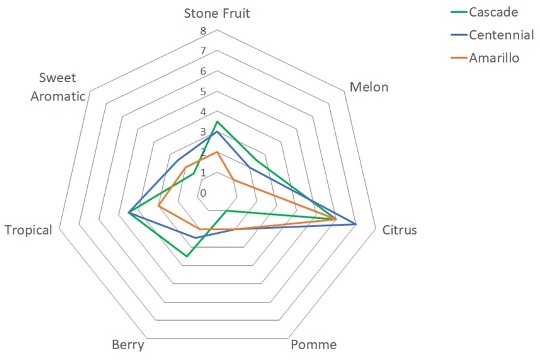
We can see that Amarillo and Centennial appear several times. Indeed, these two varieties have a high myrcene content.
Create tropical fruit aromas
Recognizing tropical fruit aromas can be a bit more complex. Indeed, the sulfur compounds responsible for these aromas (thiols and thioesters) are very easily perceptible to the nose and palate, even though they represent only up to 1% of the hop oils. Therefore, it’s difficult to rely on the chemical composition of these molecules to predict the aromas of the finished beer, as one can with the alpha acid content.
Although present in minute quantities, these molecules have a huge impact on our aromatic perception of the brew. They can very quickly impart strong notes of passion fruit, mango, or Sauvignon Blanc.
Here are the recommended hops and combinations to achieve juicy and tropical aromas:
- Mango: Simcoe, Rakau & Citra
- Passion Fruit: Strata & Moutere
- Pineapple: Sultana , Azzaca & Ariana
- Coconut: Sabro
Citra can be used as a flavor enhancer – especially to bring out tropical notes. Similarly, to add fruity roundness or enhance hints of coconut, Cashmere is very well suited for this purpose.
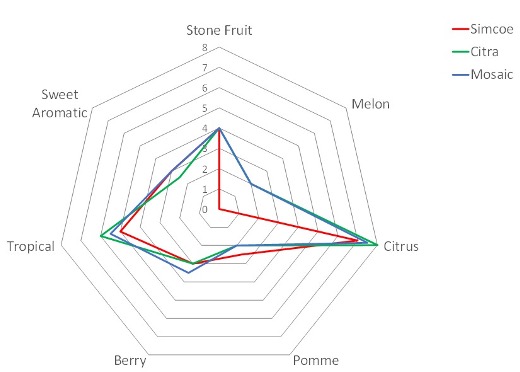
Although citrus notes are the most distinct in analyses, they aren’t necessarily the most noticeable in taste. Sulfuric molecules bring them to the forefront, and this should be kept in mind when selecting hops.
To give the indulgence of red berries and stone fruits
Some varieties have the unique ability to replicate the sweet notes of both a strawberry and a peach. One can also find very subtle aromas of melon or apple, highlighting tropical notes.
For a more subtle and complex fruity aroma, here are some combinations to try:
- Fishing: El Dorado & Azacca
- Strawberry: Huell Melon , Strata or Belma
- Blueberry: Eureka or Pacific Gem
- Cassis: Pacific Gem & Bramling Cross
The difficulty with certain red fruit aromas is that for some, they can be overpowering or evoke unpleasant flaws. Blackcurrant, for example, can also be reminiscent of ammonia. Furthermore, subtle notes of yellow fruits can be completely overshadowed by notes of exotic fruits or citrus.
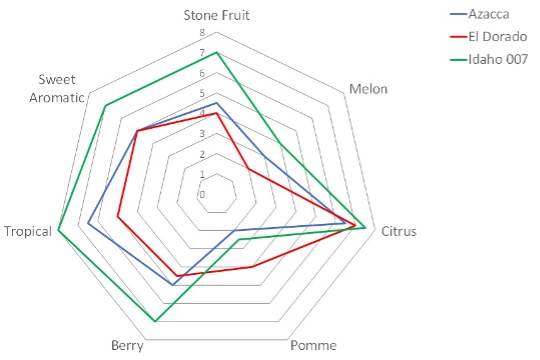
Once again, we see that citrus is a more prominent characteristic of these hops. Therefore, careful consideration must be given to pairings to highlight specific aromas. Idaho 7 has great potential for creating well-rounded, juicy, and fruity beers. It can be used hot or cold to enhance a flavor you’re looking for – whether it’s peach, mango, or blackcurrant.
Flavor enhancers
Certain hop varieties – such as Idaho 7 – are useful for highlighting and bringing out the hop they are paired with. Much like a choir behind a soloist, they will add texture and nuance, while emphasizing the dominant aroma of their partner.
We have already mentioned Cashmere , but Loral is also an excellent partner to highlight herbaceous and floral aromas.
To conclude
When choosing hops for your next brew, several factors must be considered. The percentage and details of the chemical components and survivables of each hop variety will allow you to plan when to use each variety and how to combine them to extract the most alpha acid and aroma from each. Furthermore, the aromatic notes will vary depending on the variety; it’s up to you to imagine what combinations are possible to create an explosion of flavors or a subtle cocktail in your glass.
And as is often the case, balance is key!
Of course, feel free to try beers (in moderation) with new combinations to form your own opinion.
Sources:
http://scottjanish.com/survivables-unpacking-hot-side-hop-flavor/
https://brewhq.com.au/blogs/beer-resources/hop-flavour-guide
https://beerandbrewing.com/hops-blending-and-pairing/
https://beerandbrewing.com/firestone-walkers-matt-brynildson-blends-hops-for-higher-impact/
https://beerandbrewing.com/hops-oils–aroma-uncharted-waters/