
Louis Pasteur and Beer

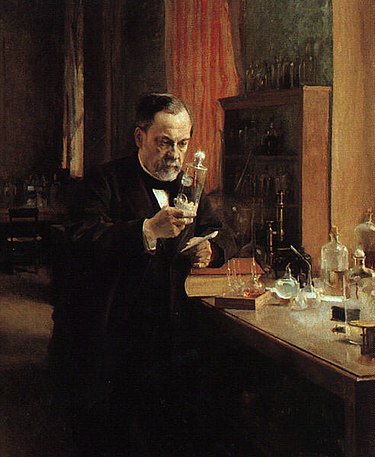
But Louis Pasteur is known for vaccines, pasteurization, and all that…? Well, not only that! Let us tell you…
For the record
Born in 1822 in Dole, Louis Pasteur was a French chemist and microbiologist renowned for his research on vaccination, pasteurization and fermentation.
Pasteur discovered that certain organisms, particularly yeasts, are capable of living in the absence of air.
He demonstrated that if microorganisms appear and develop, it is not by spontaneous generation, but thanks to spores present in the air and on food.
Pasteur created the process that would later be known as “pasteurization” and which extends the shelf life of many products.
Besides fermentation, Pasteur was responsible for many other advances and discoveries, including the rabies vaccine and a vaccine against chicken cholera, anthrax and swine erysipelas.
Did you know?
The first “patent” filed by Louis Pasteur concerned alcoholic fermentation (February 3, 1857) .
Between 1861 and 1873, Louis Pasteur then filed a series of other patents concerning in particular acetic fermentation, wine preservation processes and beer making (the latter patent was filed on June 28, 1871) .
And that’s exactly what we want to talk to you about 😉
When military defeat sparks scientific interest
Let’s start with a little history. It’s 1870, right in the middle of the conflict between Prussia (and their ally Germany) and France. France’s defeat and the fall of Napoleon III bring an end to the Second Republic and mark the beginning of the Third Republic . It is in this tense atmosphere that Pasteur’s research on beer begins!
Devastated by the defeat and capture of Napoleon III, and driven by his patriotism , Louis Pasteur set his mind on making beers as good as those of the Germans , who at the time were superior to us in the field of malted beverages.
Because it was during this period that Lager beers appeared in Bavaria ! Bottom-fermented beers, a technique skillfully mastered by the Germans . Bottom fermentation had the advantage of offering better beer preservation.
Control, pasteurize, revolutionize!
At that time, French brewers faced the problem of their beers becoming acidic during the summer, resulting in an unstable beer that had to be consumed very soon after production. Pasteur—who was already interested in microorganisms and fermentation—succeeded in demonstrating the contamination of beer starters by bacteria from the ambient air.
On June 28, 1871, Louis Pasteur filed a patent for an invention concerning a beer-making process. Having observed that fermentation is caused by microorganisms, he proposed a method to destroy them: heating the liquid to a minimum temperature of 55°C for a few minutes, then immediately cooling it. This method, applied to all perishable liquids, is known worldwide as “pasteurization.” By doing so, the alteration of the fermentation process, which posed a problem for obtaining a stable and sufficiently carbonated beer, was improved, and the beer was subsequently named ” La bière de la Revanche” (The Beer of Revenge ).
In Denmark, Carlsberg Breweries were the first breweries to pasteurize beer. Jacob Christian Jacobsen founded the Danish Carlsberg brewery (1846) and the Carlsberg Research Laboratory (1875), which quickly produced significant scientific results for the brewing world. “JC Jacobsen had boundless respect for [Louis] Pasteur,” explains Birgitte Skadhauge, Vice President of the Carlsberg Research Laboratory | Carlsbergfondet .
Finally, it should be noted that in 1877, he published “ Studies on beer ” which will contribute to the expansion of the beer market in France.
Pasteurize, yes, but…
As Une Petite Mousse points out:
” These days, a lot has changed and our way of making beer has evolved . We are now able to manage the bacteria and yeasts we put in our beers, and pasteurization is no longer vital at all . For craft brewers at least !”
Because pasteurization is still very much a reality for major breweries! Its advantages include a consistent and highly controlled taste , a longer shelf life , and easier transport. That’s why a Heineken will always taste the same, no matter where you are in the world. And that’s why our American friends, in particular, only allow pasteurized beers to be imported into their country, for example.
But these advantages are also the disadvantages of pasteurization . Pasteurized beer is frozen, with no possibility of evolution. Its taste and aroma are blocked, because the yeasts and vitamins are almost entirely destroyed… So, for large corporations, yes, but for the beer adventurers that are the craft brewers, NO!
Sources:
- https://brewsociety.fr/revolution-pasteur/
- https://unepetitemousse.fr/blog/biere-pasteurisee/
- https://www.toutsurlalevure.fr/levure-et-fermentation/louis-pasteur-le-pere-de-la-fermentation/
- https://www.pasteur.fr/fr/journal-recherche/actualites/pasteur-carlsberg-longue-histoire-science-amitie