Tettnang

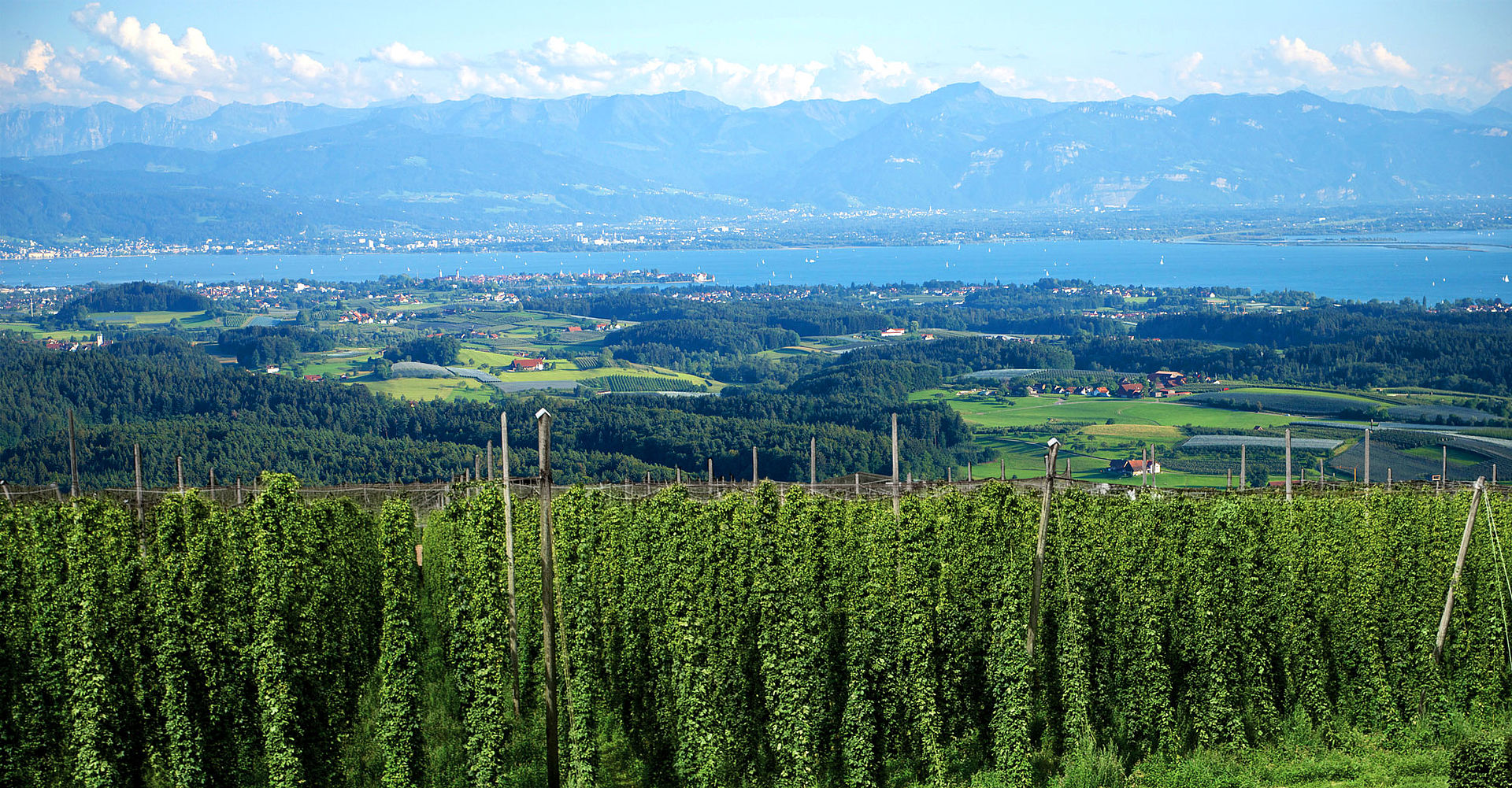
We continue our journey through hop-growing regions with this famous German region: Tettnang!
A little geography
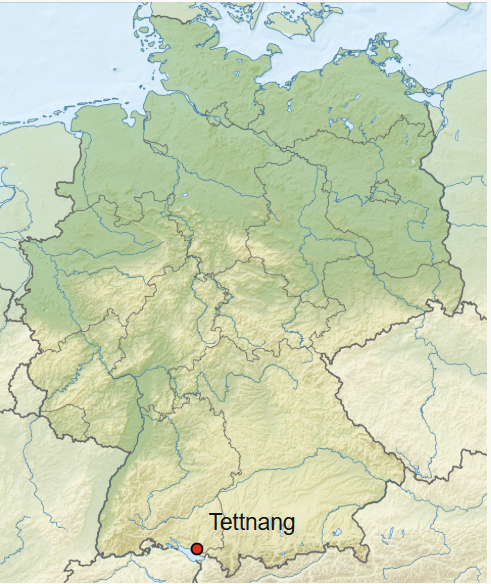
Tettnang a townin Germany, located in the state ofBaden-Württembergand in theSwabia region. It is located 7 kilometers fromLake Constance and in the Bodensee hinterland.
The town is located at an altitude of 70 meters, offering panoramic views of theSchwäbische Meer("Swabian Sea," i.e., Lake Constance) and the Alpine range towards the peaksof AustriaandSwitzerland. The eastern part of Tettnang located in theAllgäu region.
The hop-growing region is located around the town of Tettnang and the surrounding villages, on the youngest moraines on the northern shores of Lake Constance at an altitude of 350m. The landscape varies between plains, fertile valleys, and hills.
The history of hops in Tettnang
The first mention of "hops" in Tettnang to 1150, then nothing until the 19th century.
Compared to other German regions, hop cultivation in Tettnang therefore relatively late. Several years of poor harvests, widespread cattle plague, and damage caused by the Napoleonic Wars created a major agricultural crisis that reached the ears of King Wilhelm I. In 1819, the royal government of Württemberg passed a decree exempting farmers involved in hop cultivation from taxes, and in 1822 it ordered the first trials in Hohenheim.
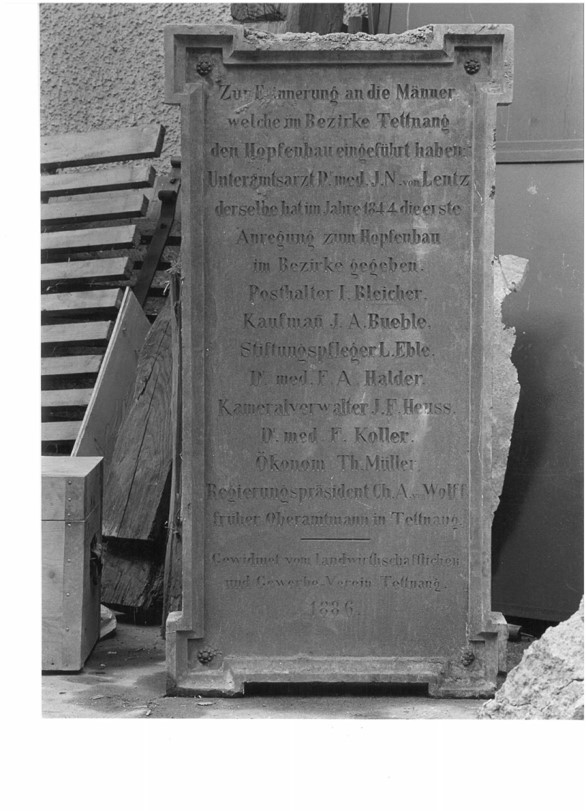
Thus, seven citizens of the town, whose names are still listed on a commemorative plaque, and the young physician Dr. Fidelis von Lentz, who worked in Tettnang "Where vines grow, hops must also thrive!"), took the initiative and, in 1844, planted the first trial gardens in Tettnang.
At the time when Fidelis von Lentz recommended hop cultivation, more than 300 hectares of vines and only three hectares of hops were cultivated in the Tettnang region, then a small town.
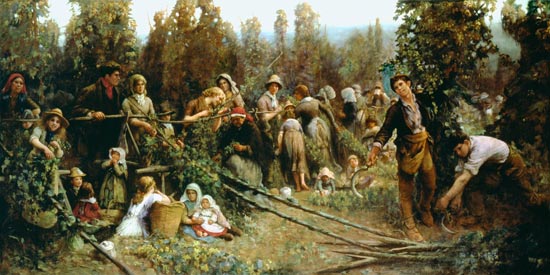
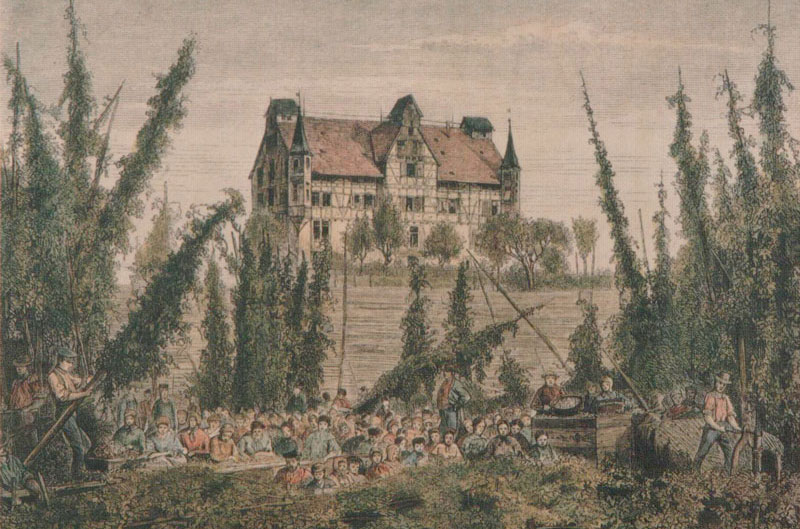
Around the same time, King Wilhelm I of Württemberg demanded that standard models of hop fields be established, and we know that around 1877, a certain Friedrich Wirth cultivated 12 hectares of hops in Kaltenberg, as shown in the illustration below:
Within a decade, the area devoted to hops reached 91 hectares, and ten years later (1874), it far exceeded viticulture with 400 hectares. The continued decline of viticulture was accompanied by an expansion in hop cultivation, which reached approximately 650 acres in 1884 and fluctuated between 550 and 700 hectares at the turn of the century and during the two world wars.
Israel Friedrich Wirth, from the Kaltenberg estate (nicknamed "Hopfenburg" or "Hop Castle"), was another pioneer and fervent advocate of hop cultivation in Tettnang this period.
He is credited with a number of inventions, such as hop drying, trellis construction, cultivation equipment, etc., which he compiled in his "Wirths Hopfenbuch" published in 1875.
Also in 1875, he organized Tettnang first German hop exhibition in Tettnang , launched quality competitions, and regularly won gold medals for the best aromatic hops from Tettnang international competitions.
After World War I, in 1921/1922, there were 1,200 hectares of crops, accounting for 10% of German production.
World War II exacerbated this decline, and by 1950, Tettnang had Tettnang of hop production. After that, production slowly picked up again, reaching 1,000 hectares in the 1970s, making Tettnang third largest producing region in Germany after Hallertau and Spalt. Tettnang even Tettnang Spalt shortly thereafter.
After 1945, when state-controlled hop cultivation came to an end, Tettnang also Tettnang internationally and became a recognized producer of Aromatic hops.
In 1947, producers organized themselves for the first time within the newly founded Tettnang Hop Growers' Association.
The 1950s to 1970s were marked by increasing mechanization. In 1956, the first four hop harvesting machines arrived in Tettnang. In 1959, the Tettnang region Tettnang a record number of active producers, with 1,382 hop farms, even though each one only had 0.57 ha of hops (a total of 785 ha). The year 1973 is considered a turning point for hop cultivation and research, thanks to the creation of the Tettnang hop research station, managed by the state of Baden-Württemberg and still in operation today.
The rigorous and systematic selection of clones of the Tettnang variety Tettnang the world's first production of virus-free hop shoots in 1984 are just a few examples of his work, which today forms the basis of the region's competitiveness. In 1975, the Tettnang Hop Growers' Association was founded, which merged with HVG Elbe-Saale and HVG Hallertau to form HVG Hopfenverwertungsgenossenschaft in 2001. Thanks to successful exports to the United States and Asia, the Tettnang region Tettnang its peak in 1997 with 1,659 hectares under cultivation.
In 2010, after ten years of trials, Tettnang protection for its brand in the form of a "protected geographical indication" (PGI) issued by the European Union in Brussels.

He is described as having:
A subtle aroma and delicate bitterness give the beers their distinctive character and, with every sip, reflect the unique landscape stretching between the northern shore of Lake Constance and the Allgäu region.
A local culture that is part of the heritage
Pour s’imprégner de l’énergie du lieu et de la manière dont le houblon fait partie de son histoire, la chaîne YT consacrée aux houblons de cette région propose une vidéo de <10mn qui met dans l’ambiance.
For those who don't speak German, the pictures speak for themselves 😉
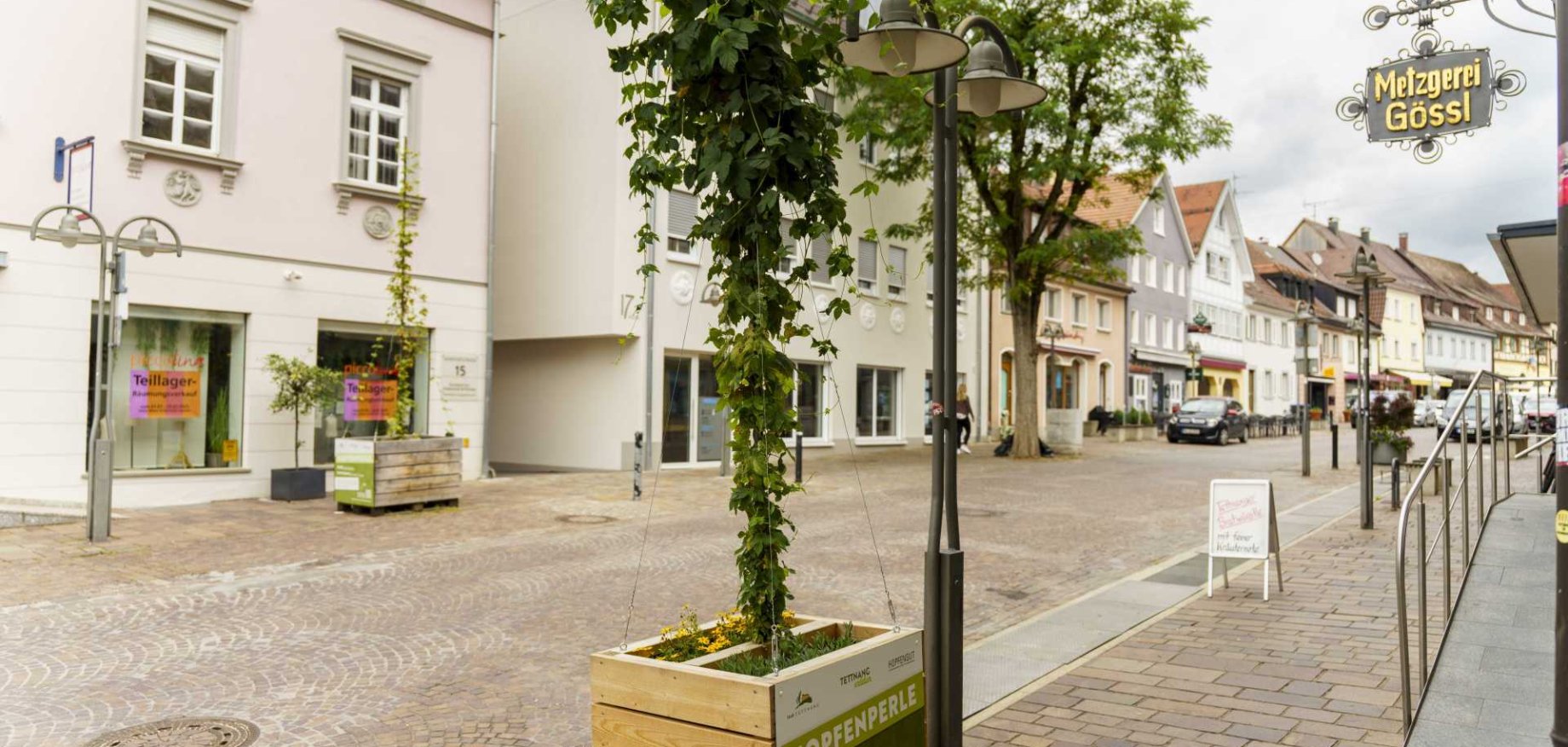
Since 2024, Tettnang also launched an initiative involving hop vines planted in the streets of the town center to highlight how this plant is an "iconic cultural element" of the region. A disease ravaged the plants, making it impossible to harvest in 2025, but the desire to renew the initiative in 2026 remains strong!
What varieties are grown in the region?
Aromatic “Noble” hops
Dual Hops
Bittering hops
A land of hops, the Tettnang region Tettnang internationally renowned for the quality of its produce; those who use it can attest to this 😉
If you would like more information about hop cultivation in general, we have written an article about its origins here.