A brief history of hops in France


Article written in collaboration with Alexandra Berry.
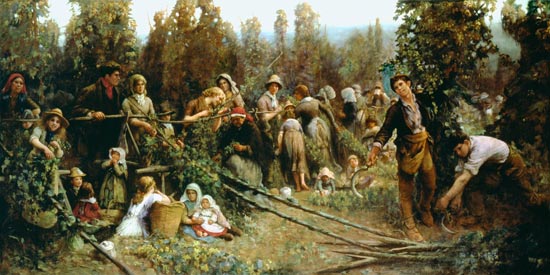
Although quite discreet, French hops have a long history dating back to the 8th century. Already mentioned in royal decrees of Pepin the Short, King of the Franks (714-768), it gradually replaced aromatic plants in cervoise, thus creating this drink that is so dear to us: beer.
Already recognized and listed as a beer ingredient by Abbess Hildegaarde of Bingen in 1070, it wasn’t until the 17th century that this plant gained a foothold in Flanders, and even longer until the 19th century for its cultivation to be truly promoted and developed in Alsace. It was the German brewer François Derendinger who, with 800 plants brought back from his travels in Bohemia, introduced hop cultivation to the Haguenau region. Among his plants was Saaz, considered the original strain of Alsatian hops.
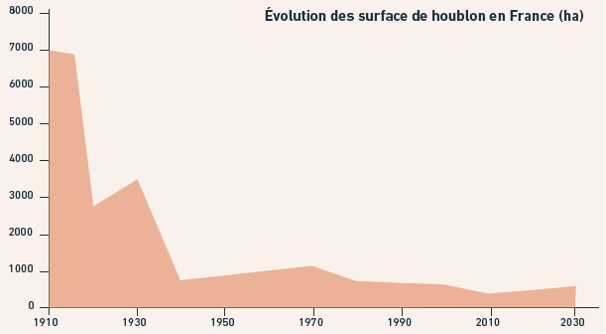
At the beginning of the 20th century, hops were cultivated on over 6,900 hectares, 58% of which were in Alsace, the rest in the North, the Côte d’Or and Lorraine. By 1916, with the popularization of beer, French hop production was considered insufficient.
“(…) Among the agricultural products for which we depend on foreign imports is hops (…) before the hostilities, beer consumption was increasing astonishingly every year: and unfortunately, we were giving too much credit to Munich and Pilsner (…)”, “(…) the industries of northern and eastern France have already made great progress in beer production in recent years. As for hops, which are cultivated in various regions of our beautiful country, everything remains to be done (…).” Jean Masson, 1916, in his thesis presented to the Institute of Agriculture of Beauvais.
Several farmers and researchers are working to demonstrate the potential of French hops and the value of French terroir for the brewing industry:
“All the necessary soil and climate conditions are found in many parts of France. Therefore, it is reasonable to conclude that hop cultivation could spread successfully in France.” Mr. Moreau, 1905, professor at the ENIA in Douai.
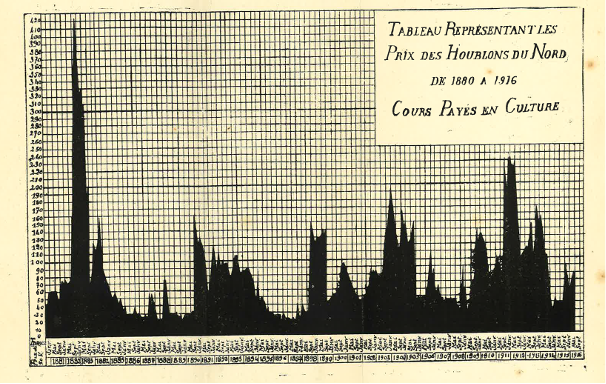
It was the First World War that first disrupted this growth, halving the production area. This loss was somewhat recovered between the two world wars, a period of growth in both cultivated areas and prices, due to significant mildew problems among German producers (and therefore increased scarcity on the markets). The golden age of hops, from 1927 to 1929, is often referred to as the golden age of hops, with prices reaching unprecedented levels.
This resurgence unfortunately did not last long, with a gradual decline preceding the Second World War. Occupied France lost its hop-growing culture, and the Germans limited production to 500 hectares.
It wasn’t until the 1960s that this production timidly began to rise from the ashes. In the 1980s, France had only 685 hectares under cultivation, 90% of which were located in Alsace. This situation was exacerbated by a major contract signed with Anheuser-Busch in 1970, which helped revive regional production and promote the local variety: Strisselspalt.
The 2000s saw a very slow increase in production, which was finally revived in 2014 with the craft beer trend that originated in the USA. As the graph below shows, we are still far from the golden age of hops in the 19th and 20th centuries, but with the terroir and the influence of French agriculture and brewing, this green plant will quickly find its place in our crops. We have no doubt about it!
Hops in France today
The world’s leading hop producers are currently the United States and Germany. France ranks 11th , with 540 hectares under cultivation in 2022, 96% of which is located in Alsace. Only 50 hectares of this area are certified organic, despite strong demand from brewers. This demand for organic hops continues to grow, reflecting the proliferation of microbreweries (the number of which more than tripled between 2012 and 2018).
To meet this demand, some (sometimes unexpected) regions have turned to hop cultivation. These regions are supported by several companies, organizations, and associations promoting the revival of French hops, such as Hopen, HOP France, Houblons de France, and more localized groups like Bière de Provence.
With the growth of microbreweries in France, increasingly focused on local sourcing, more and more hop growers are being established to meet this demand. Western France is particularly targeted by these new operations, and an association, “Houblons Grand Ouest” (Grand Western Hop Growers), was created in 2018 to support them through the Pays de la Loire Chamber of Agriculture. These groups of hop growers can hope to receive official recognition as a GIEE (Groupement d’Intérêt Économique et Écologique – Economic and Ecological Interest Group).
What are the French hop varieties?
Aramis : Aromatic use with an alpha content of approximately 8%. Its aromatic profile is herbaceous and floral, sometimes with lemon notes. Created in 2009, Aramis is the first new variety resulting from the Comptoir Agricole’s varietal research program.
Barbe Rouge : A variety derived from Strisselspalt, it is considered DUAL, meaning it is both bitter and aromatic. With very fruity notes, particularly of red berries, it has an alpha acid content between 8 and 10%.
Bouclier : Developed through a varietal research program sharing origins between France and England, created in 2005 from a cross between Strisselspalt hops and an English male plant. Its aromas are delicate, herbaceous, and spicy, and its alpha acid content varies between 3 and 5%.
Elixir : This hop variety was created in 2016, initially called GS10. It is a highly aromatic hop, with an alpha acid content of 6%, created to produce highly aromatic IPAs using French hops. Strong fruit and citrus notes are particularly pronounced when dry-hopped.
Mistral : Mistral is a particularly aromatic hop with notes of jasmine and rose. Some also detect hints of white fruits like lychee or even white grape. Developed through the Comptoir Agricole research program, it is a cross between a Cascade female and a Strisselspalt male. With an alpha acid content between 6.5 and 8.5%, it can also be used for bittering.
Strisselspalt : Also aromatic, its alpha acid content is between 3 and 5%. It can offer spicy or floral, citrus, and fruity notes. It is a very noble and refined hop, favored for dry hopping to preserve its lemon notes.
Tardif de Bourgogne : This aromatic hop is grown in small quantities in the Alsace region and offers an alpha acid content between 3 and 6%. Very difficult to find on the market, this variety had disappeared from French hop cultivation and was brought back to the brewing scene thanks to Locher-Hopfen, a hop grower in Tettnang who rediscovered it in Haute-Marne. Originating from a clonal selection of an old French variety, it reveals soft, herbaceous nuances of bay leaf, anise, or even, for some, apricot. ( We found it certified organic on the other side of the ocean…yes, really…)
Triskel : An 8-9% alpha acid hop with floral and citrus notes. It is the result of a cross between Strisselspalt and an English variety called Yeoman. It thus offers the same aromatic citrus and floral notes but can also be used as a first hop for a pronounced bitterness.
These varieties are being adopted by brewers for their finesse, approaching the noble hops of Germanic regions. Varietal research continues in order to develop aromatic hops capable of producing the juicy and fruity IPAs that are currently trending in the craft beer scene. The classic varieties mentioned above can be used to create superb saisons, Pilsners, and interesting and complex sours.
Another French phenomenon is the growing interest in organic hops. According to Hopen, 70% of new brewery project leaders are committed to organic farming. This demand is reflected in the crops themselves, although it takes three years to obtain organic certification for one hectare of hops in conversion. Yes, organic farming is something that takes effort!
To meet the demand from breweries, more and more hop farms are springing up in France and cultivating French varieties. France will once again be able to boast of its brewing heritage!
Sources:
https://www.comptoir-houblon.fr/
https://www.france-houblon.fr/